

Two Lovers
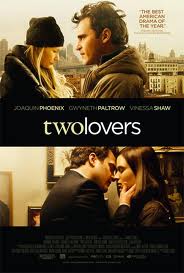 I had not seen the poster for the film because otherwise I would have noticed that Two Lovers is not about two people. During the film you realize it is about at least 3, possible 4 people, who are trying to figure out who they want to be with. We all know that this is not an easy question and some of us are a lot better in figuring it out. Two Lovers is nothing like The Lover which indulges in sexy cinematography. Here the existential problem of sorting through all the conflicting impulses is in foreground. The director does not seduce you with romantic landscapes and enticing human bodies but rather uses the rather dreary background of a Brooklyn apartment building to stage a drama of the human heart. This is not a film you have to see but if you do see it, you will agree that it manages to penetrate the human condition much more deeply than your typical romantic comedy.
Broken Embraces
 Pedro Almadovar surprises you again with Broken Embraces. Unlike Woody Allen who now makes the same movie over and over again, Almadovar in all his recent films has broken new ground in his quest to lay bare before our eyes the variety in the human experience. During the first hour I wondered where the film was going and feared that Almadovar was following perhaps in Woody Allen’s recent footsteps. But then the movie takes a turn for the expected and pace accelerates, leaving you breathless about the turn of events. Almadovar has constructed a tragic mystery that nonetheless lifts your spirit because you realize that—however fleeting happiness with another person may be—one second of it may nourish you for eternity.
Continue Reading
Almanya—Welcome to Germany
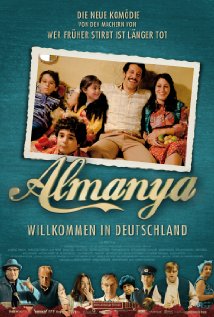 When the economy took off in the 1950s, Germany experienced severe labor shortages. So employer unions and politicians hatched the idea to import guest workers from Turkey and other southern European countries. By the middle 1970s these “guest workers” were allowed to bring their families to Germany and settle there permanently. Today, about 3.5 million people of Turkish origin are living in Germany. Because for hundreds of years citizenship in Germany has been tied to blood relationship, integrating foreigners into German society has been a lot more difficult than integrating new waves off immigrants into the U.S. Children of immigrants in the U.S. see themselves by their teenage years as American wherever they come from. German society made it very difficult even for German-born children Turkish families to identify themselves foremost as Germans. During the past decade a number of films have been made by such children, chronicling the identify challenges their lives in Germany would entail. The best one to date is Almanya - Willkommen in Deutschland.
Cedar Rapids
 Selling insurance is one of the most boring jobs in the world. But some people’s personality seems to be uniquely suited for this line of work. Tim Lippe is one of them. The most excitement Tim has experienced in life to date is having sex with his former 7th grade teacher (Segourney Weaver) once week. But now he is sent on a road trip to Cedar Rapids. There he is introduced to the most fun insurance people you can imagine. Gorgeous women (e.g. Anne Heche) are chasing this nerd and giving us a few laughs. I enjoyed the film a lot more than the 40-year-old virgin but it definitely is not a film you must see.
Bridesmaides
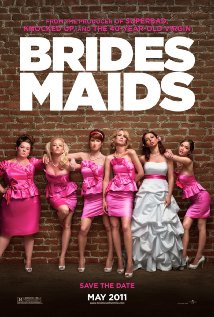 Watching a teenage girl lose her boyfriend of 3 weeks is a lot less scary than watching a woman in her late 30 losing her boyfriend of three years. The film relies on the fact that as adults we all realize that the teenage girl is probably better off being “back on the market” where her twenty-year-older self enters a “bad market.” There are already many film in the Getting-Ready-for-a-Wedding genre. Except for the last 15 minutes the film is banal and boring compared to even such light fare as Four Wedding and a Funeral. If you want to see an initially funny and the deep film about marriage, see the splendid Barney’s Version. The writer Mordecai Richler uses a plot line in Barney’s Version that I once had developed but now no longer can claim as mine: Boy waits long time to marry. Has found great spouse. But at the wedding he meets someone who he instantaneously recognizes as the person he should have married. Bridesmaides never reaches such deep waters.
Boys Don’t Cry
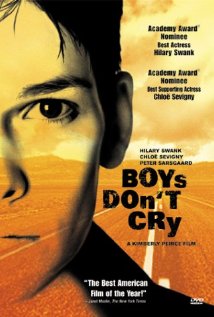 I knew nothing about the plot of Boys Don’t Cry. But somehow the title was so familiar. It must be a famous movie. For the past year or so I have been participating in a video rental service that sends me in a new film from my wish list whenever I send the previous one back. A few weeks ago Boys Don’t Cry arrived in my mailbox. For me the charm of the film was that I had no idea what would happen, whether the film was really good and whether I would watch it until the end. I want to leave it that way for you. The film is definitely worth seeing. It is a bit heavy but I would not want to have missed it. The acting of Hilary Swank is spectacular. I found her more compelling in this film than A Million Dollar Baby. Boys do cry sometimes.
Never Let Me Go
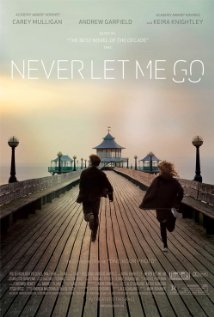 The book on which the film is based was shortlisted for the Booker Prize and was nominated by Time magazine as the best novel of 2005. Every basic ethics discussions ponders the question whether it is moral to take organs of one person to save a few other persons. The film is sophomoric, disgusting and sad.
Lord of the Flies
 Lord of the Flies is not entertainment in the popular sense of the word. It places high demands on the viewer. Think of it as going to a museum whose paintings are challenging for the senses; or going to the theater to see a modern piece like Waiting for Godod. A group of British children become stranded on a desert island without any adults there to supervise or guide them. I am not sure if there is a recorded case in history that would gives us any clues how a group of isolated children would actually organize their society. In the book by the same name, William Golding, imagines what kind of society the children would build for themselves. In his vision, the forces of savagery will appeal so strongly to the children’s mind that they will be hard to resist. Adult societies, of course, often struggle with the same forces. The 2nd part of the film explores this battle between the forces of savagery and civilization. If you want to know how it ends, find an evening when you are willing to sit through Peter Brooke’s film.
The King’s Speech
 Think back to the terrifying moment when you gave your first public speech. You may be a great storyteller when surrounded but friends and family. But now you step onto the podium looking out to an audience of strangers who are all focused on you starting your speech. Your mouth is getting dry, your tongue is getting heavy. The audience is waiting for you to say something and you know you might not be able to pull this off well and be branded failure in full public view. Now imagine that you a have a stammer since childhood. This moment will be even more terrifying. Welcome the opening scene of The King’s Speech, which chronicles the ascent of George IV to the British thrown in 1936. During the first half of the film I was a bit unconformable because it seemed to me a rather overt promo for the Monarchy. While I don’t object that countries like Great Britain and Sweden continue to having a King or Queen, I don’t support the idea that a country like the U.S.A or Germany should bring in a monarchy. But later on the film becomes so good that I left the theatre content.
A Passage to India
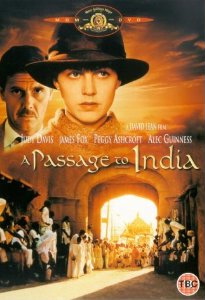 Do novelists and poets change the world or do simply please and entertain us? I suspect that the best novelists sense the early signs of a new mood and outlook. If truly gifted, they are able to put in words and stories such a new outlook, infect the rest of us with it, and thereby pave the way for sometimes dramatic social changes. In his novel A Passage to India, E. M. Forster exposes the hypocrisy the British engaged in while in ruling India. While thinking of themselves as the most civilized people on earth, they treated Indians as subhuman. British rule was already questioned in 1924 when Forster’s novel was published. Yet it took another 23 years until Indian independence. Watching the film version of the novel, it seems to me that British readers of Forster’s novel would have been infected with the sense that British rule is unjust. The first 60 minutes of the film are slow and I was about stop watching. But then the drama picks up and the next 90 minutes are wonderful.

© 2026 Peter Murmann. Powered by ExpressionEngine.
