

Melinda and Melinda
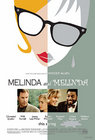 Is it more accurate to see life as a comedy or a tragedy? This is philosophical question gives Woody Allen the hook to explore the complications that arise when an old friend shows up at her friend’s dinner party with more than a little bit of baggage. I was intrigued enough to take another look at Woody Allen who has become too repetitive for me in recent years. The film gives you a few good laughs, particularly when Will Farrell’s muses over whether it would be OK for a liberal Democrat to have sex with a Republican. But on the whole it doesn’t break any new ground. Allen’s problem is that he makes too many movies (one a year), leaving him no time to make a really good one. The storyline gives Radha Mitchell (who also played in Finding Neverland and Man on Fire the opportunity to show just how good an actress she is. Somewhat irritatingly you feel that Woody Allen is stuck in Will Farrell’s body because you hear Woody talking.
Closer
 Closer is depressing in every respect. Nobody gets closer to love, to beauty, to understanding. Not the writer of the script (Patrick Marber), not the director (Mike Nichols), not the viewer (you and me). Watching the film, I felt real anxiety about getting old. Almost 40 years ago Mike Nichols directed Who is Afraid of Virginia Wolf, a wonderful movie based on a play in the same name. Both movies focus on psychological warfare that can break out in relationships. But Closer has lost all sense of psychological believability, drowned out by what I now fear to be the tragic desires of old age. As a young man, Nichols had clear before his eyes that a highnoon shootout in a relationship is all the clashing of personalities, life plans, accomplishments and backgrounds. Skip Closer and get closer in Who is Afraid of Virginia Wolf.
The Motorcycle Diaries
 On an abstract level all novels are either stories about travel or character development. The first half of The Motor Cycle Diaries falls solidly in the travel category. Not being burdened by responsibilities for others, two young people decide to take a motorcycle tour through the different countries of South America. The camera captures arresting pictures of the landscape that made me want to pack up my bags and see the continent with my own eyes. Somewhat unexpectedly the second half of the movie tries to become a film about character development. At the end we are told that one of the two became a famous political figure. The character development mission of the film failed utterly to prepare me for what one of the two men ended up doing in life.
Finding Neverland
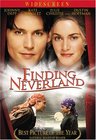 This enchanting film dramatizes how the playwright James Matthew Barrie (1860-1937) created with his best known work, Peter Pan. In 1903 Barrie’s latest play is a total failure with audiences and critics alike. To distract himself from his creative problems, Barrie (John Depp) starts playing daily with the four fatherless boys and their widow mother (Kate Winslet) who he met in the park. One of the boys, Peter, is particularly distraught over his father’s death. Barrie encourages him to take up writing to let his imagination find beauty and happiness. The interactions with these four boys give wings to Barrie’s imagination and allow him to write Peter Pan. The script based on a marvelous play; the acting is superb. Particularly moving is the performance of Freddie Highmore who plays Peter. The film inspired me to put Peter Pan on my reading list.
The Aviator
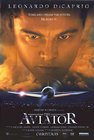 The Aviator received the most Academy Award nominations for the year 2004, with 11 total. This is very difficult to understand because the film is a painfully weak piece of work for Martin Scorcese (director) and John Logan (writer). Both Scorcese in Gangs of New York and Logan in The Last Sumarai have shown that they can do justice to historical material on the big screen. After seeing or reading a good biography we are supposed to understand a person better. Logan’s script about Hughes fascinating life fails to explain anything. All Logan does is to copy the explanatory structure of Orson Well’s Citizen Kane and provide us with a contrived childhood explanation for Hughes adult life. Scorcese empathizes with Howard Hughes so strongly that he seems to have lost his own directorial mind in the process. Scorcese, for example, designed each year in the film to look just the way a color film from that time period would look. Furthermore, many of the sets are designed very cheaply, perhaps also to imitate movies from the 1920s and 1930s. Unfortunately, this means that you never forget that the drama is staged. Rather than lend sophistication to the film, it makes the film look amateurish. Then suddenly, out of the blue, comes a scene in which Hughes crashes with his plane in the middle of L.A. Using the best special effect technology that money can buy today, the scene has more realism than most scenes in the film. Clearly enormous amounts of money and effort went into the scene. But it is clearly over the top in its scale and its violence compared to anything that happened before. At this moment you murmur to yourself: What happened to Scorcese legendary touch? The only explanation I can offer for why the The Avatior won the Oscars for best art direction, best cinematography, and best costume design, as well as for best-supporting actress is that the average voters in the Academy of Motion Pictures are so self-absorbed that they would vote rather for a bad movie about Hollywood than a good film about another industry. The one Oscar that strikes me as well-deserved is Kate Blanchett’s for the supporting actress. Blanchett does an outstanding job playing Katherine Hepburn. If Howard Hughes were alive today, he would have made a better movie.
The Life and Times of Frida Kahlo
 PBS broadcasted today for the first time a documentary on the painter Frida Kahlo If you have not seen the Hollywood motion picture Frida with Selma Hayek in the role of Frida, you will find the documentary very stimulating. But if you have seen Selma Hayek’s marvelous Frida, you realize just how accurately the Hollywood film captured the life of this pioneering Mexican woman. The problem for this documentary is that there was nothing left out in the Hollywood picture. Hats of to Selma Hayek and the people who made the Hollywood motion picture about Frida.
 (Here you find a schedule of future broadcasts of the documentary.)
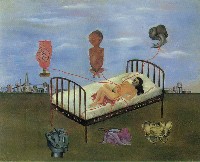
Some of Frida’s paintings trying to express her inner turmoil are the most arresting paintaings I have ever seen expressing humon emotion. There is a wonderful website in Italy that provides links to many of her paintaings.

Continue Reading
Bowling for Columbine
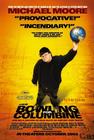 My expectations were only moderately high after having been disappointed by Moore’s under-researched Fahrenheit 9/11. Already during the first couple of minutes, you get the sense that Bowling for Columbine is a superbly crafted film. The symbol of guns is so deeply embedded in the American psyche and the facts about gun violence in America are so well documented that Moore can use a simple technique: Let people from all walks of life talk about their views on the issue and what emerges is the material for an amazing picture of American society. Moore in the best sense of the word directs peoples’ statements into a gripping tale about contemporary America. You are shocked, you learn, and you laugh. The Oscar 2003 Oscar for best documentary is well-deserved. The film is a masterpiece.
As an aside: I watched this movie late at night at the gym on the Stairmaster. Toward the middle of the film a particularly funny scene made me laugh out loud. Not far from me an employee was cleaning up the gym. The five-foot one slender blond girl seemed to tell me something but I couldn’t hear what she was saying with my headphone on. I took them off and now could understand her words. “I thought you were laughing about me,” she says. “No, I am laughing about a scene in Bowling for Columbine. It is really funny,” I reply. “I hear that it is good but I don’t like its message,” she adds. “I grew up in Michigan with guns and I believe that everyone has a right to wear them.” Over the next minutes, she utters the same justifications for guns that Moore captured on his film. “Everyone has a right to defend oneself. It is in the constitution. I am small 5 foot 1 woman. If someone tries to rob me in my car, I can only defend myself with a gun. And when people attack someone, they deserve to be shot.” I objected that shooting someone because they want to take $20 out of your wallet is perhaps a bit extreme. “ “No, I am allowed to defend myself with a gun.” Michael Moore pointed his finger on why so many people pay dues to the National Rifle Association. They feel insecure and believe that a loaded gun in the house or the car is going to make them safer. But what I also realized in this conversation is that people are socialized into the belief that guns are an American right enshrined in the constitution. Gunn ownership forms part of their self-identity. I presented the obvious objection to the belief that the constitution allows everyone to bear arms for self-defense (rather than to form a militia to protect the commonwealth): “So, you think I can bring into this gym my personal nuclear weapon in case some of the big guys over there try to beat me up or take my DVD player?” Then she said, “No, that would be too extreme.” What I realized at this moment is that when people like her insist on the constitutional right to bear arms, they insist on being able to do what they grew up with. Since they did not grow up in a society in which everyone brought his or her little nuclear weapon to the gym, they don’t have difficulty prohibiting the right to bear nuclear arms. But since they are guided by emotions and not logic, they don’t understand that logically speaking this makes no sense. The parents of the children who were killed at the Columbine High School believe that it is simply too extreme in an urban and modern society to allow kids to get easily get their hands on guns.
My expectations were only moderately high after having been disappointed by Moore’s under-researched Fahrenheit 9/11. Already during the first couple of minutes, you get the sense that Bowling for Columbine is a superbly crafted film. The symbol of guns is so deeply embedded in the American psyche and the facts about gun violence in America are so well documented that Moore can use a simple technique: Let people from all walks of life talk about their views on the issue and what emerges is the material for an amazing picture of American society. Moore in the best sense of the word directs peoples’ statements into a gripping tale about contemporary America. You are shocked, you learn, and you laugh. The Oscar 2003 Oscar for best documentary is well-deserved. The film is a masterpiece.
As an aside: I watched this movie late at night at the gym on the Stairmaster. Toward the middle of the film a particularly funny scene made me laugh out loud. Not far from me an employee was cleaning up the gym. The five-foot one slender blond girl seemed to tell me something but I couldn’t hear what she was saying with my headphone on. I took them off and now could understand her words. “I thought you were laughing about me,” she says. “No, I am laughing about a scene in Bowling for Columbine. It is really funny,” I reply. “I hear that it is good but I don’t like its message,” she adds. “I grew up in Michigan with guns and I believe that everyone has a right to wear them.” Over the next minutes, she utters the same justifications for guns that Moore captured on his film. “Everyone has a right to defend oneself. It is in the constitution. I am small 5 foot 1 woman. If someone tries to rob me in my car, I can only defend myself with a gun. And when people attack someone, they deserve to be shot.” I objected that shooting someone because they want to take $20 out of your wallet is perhaps a bit extreme. “ “No, I am allowed to defend myself with a gun.” Michael Moore pointed his finger on why so many people pay dues to the National Rifle Association. They feel insecure and believe that a loaded gun in the house or the car is going to make them safer. But what I also realized in this conversation is that people are socialized into the belief that guns are an American right enshrined in the constitution. Gunn ownership forms part of their self-identity. I presented the obvious objection to the belief that the constitution allows everyone to bear arms for self-defense (rather than to form a militia to protect the commonwealth): “So, you think I can bring into this gym my personal nuclear weapon in case some of the big guys over there try to beat me up or take my DVD player?” Then she said, “No, that would be too extreme.” What I realized at this moment is that when people like her insist on the constitutional right to bear arms, they insist on being able to do what they grew up with. Since they did not grow up in a society in which everyone brought his or her little nuclear weapon to the gym, they don’t have difficulty prohibiting the right to bear nuclear arms. But since they are guided by emotions and not logic, they don’t understand that logically speaking this makes no sense. The parents of the children who were killed at the Columbine High School believe that it is simply too extreme in an urban and modern society to allow kids to get easily get their hands on guns.
Napoleon Dynamite
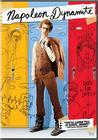 The typical high school movie has a plot line that goes like this: Students collectively arrive at standards for deciding a status order for the group. Good looks, athleticism, and social skills typically form the standards by which each student is ranked. The high-status people form an in-group with a very strict social social boundary, keeping the majority of lower status students in the out-group. The cool people constantly pick on the nerds and remind the latter that they would like to join the in-group, but will never be allowed to do so. After considerable abuse, the nerds commiserate with one another and form a mutual support group. As the drama unfolds, the cool people turn out to be shallow and not very intelligent. The nerds, by contrast, reveal themselves to be deep, authentic, capable of true friendship, and above all intelligent. These qualities allow them to defeat the cool people at their own game (revenge of the nerds).
Bridget Jones: The Edge of Reason
 If you are flying to the West Coast this month with United Airlines, you are presented with the Briget Jones sequel. Just like the first film, it is a light romantic comedy. Competent writers were hired to put together a script that delivers the same kind of effects as the first movie. It is not profound in any sense of the word. The film feels over-engineered, except with regard to Bridget’s boyfriend Mark. The writers left him without any trace of character. You forget Bridge Jones II the moment you step out of the plane. If you are looking for a playful light romantic comedy, bring your DVD player on board and watch Renée Zellweger in Down with Love. If you want to see how good an actress Zwellweger you might want to watch her in the marvelous film Cold Mountain, which I reviewed on this page early last year.
Man on Fire
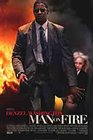 Men on Fire is the most fantastic thriller in years. It pulls off what most films of this genre lack: Emotional depth in the midst of an action-driven plot. Denzel Washington plays John Creasy, a retired CIA operative/contract killer whose conscience has got the better of him and led him to the whiskey bottle. Visiting a former comrade in Mexico, the old friend (Christopher Wallken) ropes him into the job of protecting the young daughter of a Mexican industrialist Samuel Ramires (Marc Anthony) whose American jet-set wife Lisa fears for the life of their daughter after Mexico City is caught in a wave of child-kidnappings. Creasy only reluctantly agrees to serve as the body guard of the nine-year-old Pita (Dakota Fanning) because he is afraid that the body of an alcoholic would be too weak to protect the girl. But Creasy has no idea how difficult Pita will make it for him to continue on the path that he has chosen.

© 2026 Peter Murmann. Powered by ExpressionEngine.
