

 Want to know what the average American is up to in terms of his or her sexual patterns, here you can find out.
David Brown reports in the Washington post on a new A sweeping survey of Americans’ sexual behavior
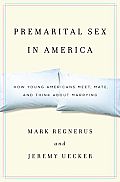
Evan Hughes provides a thoughtful review in TNR of Premarital Sex in America: How Young Americans Meet, Mate, and Think about Marrying by Mark Regnerus and Jeremy Uecker.
A sweeping survey of Americans’ sexual behavior
By David Brown
Washington Post Staff Writer
Friday, March 4, 2011; 12:50 AM
Among the findings of a sweeping federal government survey of American sexual behavior is one that may surprise those bewailing a permissive and eros-soaked popular culture: More than one-quarter of people interviewed in their late teens and early 20s had never had sex.
And the number was growing.
The latest round of the quaintly named National Survey of Family Growth found that among 15-to-24-year-olds, 29 percent of females and 27 percent of males reported no sexual contact with another person ever - up from the 22 percent of both sexes when the survey was last conducted in 2002.
“The public’s general perception is that when it comes to young people and sex, the news is bad and likely to get worse,” said Bill Albert, chief program officer of the National Campaign to Prevent Teen and Unplanned Pregnancy, an advocacy organization in Washington.
The seventh and latest round of the survey, first done in 1973, provides a corrective to that view.
“Many, many young people have been very receptive to the message of delaying sexual activity,” Albert said. “There’s no doubt about it.” He added that the nearly 40 percent reduction in teen pregnancy since the 1990s - which experts attribute to both increased condom use and increased abstinence - represents “extraordinary progress on a social issue that many once considered intractable.”
The uptick in abstinence is one of many revealing facts arising from structured interviews with a random sample of 13,495 Americans, ages 15 to 44, that were done from 2006 to 2008. The findings provide evidence for almost every theory and supposition about the nation’s secret sex life.
The survey results, released Thursday, suggest that oral sex may be a gateway to vaginal sex but that for some teens it is a stopping point. Most adults are monogamous. About 4 in 10 adults have had anal sex. Women are more likely than men to have same-sex liaisons. Or at least are more comfortable talking about them.
Conducted by the Department of Health and Human Services, the survey provides basic information for public health policymakers concerned with such issues as sexually transmitted disease. There is no single fact that it is trying to ferret out or message that its 49 pages of text and tables seek to deliver.
But Anjani Chandra, the demographer who is the lead author of the report, said that “for some people, it may be news that these behaviors exist at all in the general population.”
When first run, the survey queried only married and formerly married women. Single women and then men were later included, as were more detailed questions about sexual practices.
Parts of the survey are now so explicit that even though the interviewer and subject are face to face, some questions are asked and answered using a computer screen so that the answers are completely private.
“We know from previous work that you get better reporting when you use” computer-assisted interviewing, said John Santelli, a pediatrician and epidemiologist at Columbia University who has researched sexual behavior in teens. “I think this kind of data is pretty reliable.”
Among the more sensitive subjects is teenage oral sex.
The latest results provide support for the idea that some teens limit their sexual activity to oral sex either to preserve their virginity or because they view such encounters as safe. Public health officials say that the latter is a misconception and that some sexually transmitted infections, such as herpes and human papillomavirus, can be transmitted by oral-genital contact.
Among 15-to-17-year-olds, 7 percent of females and 10 percent of males report having oral sex but no vaginal sex. That fraction, however, declines rapidly among older respondents. In the 20-to-24 age group, only 3 percent of females and 4 percent of males report oral-sex-only activity.
In the 25-to-44 age group, however, 98 percent of females and 97 percent of males report having had vaginal intercourse, with about 90 percent having oral sex as well. Slightly more than one-third (36 percent) of women and 44 percent of men report having had anal sex.
Across the entire age span surveyed - 15 through 44 - 13 percent of women reported some “same-sex sexual behavior” in their lifetime, compared with 5 percent of men. For women, the fraction was up slightly from 2002, and for men, it was down slightly.
Many more men (21 percent) than women (8 percent) report having at least 15 sex partners in their lifetimes. Hispanic women were less likely to report same-sex activity (6 percent) than black (11 percent) or white (15 percent) women.
There were small effects related to education. For example, 9 percent of women with bachelor’s degrees or higher reported same-sex encounters, compared with 15 percent of women who had not graduated from high school. On the other hand, 6 percent of male college graduates reported such encounters, compared with 3 percent of men who had not finished high school.
The survey also asked about sexual identity and orientation.
Among 18-to-44-year-olds who described themselves as heterosexual, 9 percent of women and 3 percent of men reported having same-sex encounters. On the other hand, 15 percent of women and 12 percent of men who described themselves as homosexual or bisexual had never had a same-sex experience.
Not enough people were interviewed to provide state-by-state findings. But there are other population categories - urban vs. suburban vs. rural residence, religious affiliation, living arrangement - that can be specifically studied. Thursday’s report is just the first and most basic cut.
“The data will be set free, and I’m sure any number of researchers will pounce on it and do all sorts of interesting analyses,” Chandra said.
The Meet Market by Evan Hughes
Premarital Sex in America: How Young Americans Meet, Mate, and Think about Marrying
by Mark Regnerus and Jeremy Uecker
Oxford University Press, 312 pp., $24.95
IN A COLLEGE CAMPUS STUDY in 1989, physically attractive people approached opposite-sex students and asked, “Would you go to bed with me tonight?” Not a single woman said yes, but seventy-five percent of men accepted the invitation. This gender disparity forms the basis of the theory of “sexual economics,” which starts from the familiar premise that most guys want sex to be as easy as possible. Women generally want something else to be provided first, often along the lines of commitment, affection, security, love (perhaps you have heard this list before). These things constitute the “price” of sex for men. The going rate is governed by the norms in a given milieu, in much the same way that housing costs are determined by a local market. Since everyone is keen to (inconspicuously) compare notes, a web of interconnection takes shape so that each transaction has some effect on the marketplace as a whole.
Mark Regnerus and Jeremy Uecker, sociologists both, rely heavily on this theory to explain the sex lives of young adults today. The rise of “the hookup culture” at colleges, they argue, can be attributed in part to the increasing scarcity of men on campus—an oversupply of sellers works to a buyer’s advantage. Sexual economics also suggests that many women look unkindly on promiscuous members of the same sex out of the same impulse that makes retailers angry when Wal-Mart comes to town: they are being undersold, and now they have to give discounts or lose customers.
Regnerus and Uecker are either indifferent or tin-eared about how distasteful this idea is:
Sex might cost little or nothing—a few drinks or some attention and compliments, or simply a promise to be discreet about the liaison. Typically it’s more expensive than that, such as a perceived commitment to being in an exclusive relationship for a while. The highest price a man can pay is a lifetime promise to share all his wealth, income, and affections with a woman exclusively.
Equating an intimate act to a business transaction is not only crass and reductive; it is also analytically misleading. The analogy to commerce implies an adversarial situation wherein the buyer always wants to pay the minimum and the seller wants to get the maximum. But men often find themselves bestowing attention, falling in love, and getting married after they have already been sleeping with the woman in question. Sexual economics has trouble accounting for that. Men willingly overspend, which describes approximately no one who buys a car. Similarly, the pay-for-play hypothesis fails to capture the fact that most women do not want to extract caring and love from a person disinclined to offer it, and they do not see sex as something they wish they could avoid until marriage.
Of course Regnerus’s and Uecker’s analysis bears some resemblance to reality. Any straight nightlife spot will illustrate that there is a market for sex in which, as a rule, men represent the demand side of the equation and women the supply side. While hope for a deal may abound on both sides, women are looking for good reasons to make one, which sets off a collective merry-go-round of shopping and haggling. That this concept is not terribly surprising represents a problem for the book. Shaky when you examine it closely, the sexual economics theory in its broad outline seems almost trivially true: it describes what we know but does little to explain what we do not understand.
Despite these missteps, however, the book does manage to illuminate some important questions about sex in contemporary America. Based on a combination of data from large research surveys and the authors’ interviews with college students, the book reads at times grimly like an article from an academic journal, but arresting findings periodically appear: a young woman’s attractiveness is statistically irrelevant to how much sex she is having; among female college graduates, politically conservative respondents under twenty-eight were three times more likely to be married, while liberals were fifteen times more likely to be living with a boyfriend; those most able to financially support children are least likely to be having them, which has not yet depopulated the upper-middle class in America, but it has in Spain and Italy; the more sexual partners a woman has had, the more likely it is that she is depressed.
The last fact arises from the discussion of a touchy subject that Regnerus and Uecker handle well: the emotional travails that sexual decisions can bring. Consensual sex, they observe, appears to be an arena of free choice, but in practice it doesn’t quite feel that way, especially for young women. A woman might experience pressure to sleep with her boyfriend—even if he does not apply any pressure—because she thinks four months is a long time for a man to wait. The mix of societal cues that gave her that idea creates a background noise that drowns out the question of her personal willingness. Meanwhile, the boyfriend may be conditioned by Internet porn to think that four minutes is too long to wait, but he may have learned in sex-ed that you never push. We have a conflict, then, among different sexual “scripts,” to use a term Regnerus and Uecker often invoke; various sets of norms as to “what you’re supposed to do” are clashing.
In a chapter called “Red Sex, Blue Sex,” the authors explore the differing scripts in conservative and liberal America. To their credit, here they make things difficult for themselves by discussing not party affiliation alone but a fuzzy yet recognizable constellation of related factors, including religiosity, level of education, and social attitudes. “Reds,” as the book refers to them, are not faring very well at certain measures of family values, including pornography consumption, divorce, and teen pregnancy—the last fact one that Democrats noted with some enthusiasm when the country learned of Bristol Palin’s pregnancy.
“Blues,” though, have their own problems, which Regnerus and Uecker take tentative stabs at addressing. Urban, educated progressives—citizens of what has been called “the NPR archipelago”—use contraception more often, wait longer to marry, and experience fewer divorces. (Many single people who speak fearfully of a 50 percent divorce rate actually face a far lower probability given their circumstances.) This all sounds like success to blues but at lower incomes family stability begins to deteriorate. Blues also suffer more often from a problem very difficult to quantify: confusion. If you believe pornography and cohabitation and premarital sex are wrong, then you will likely feel guilty when you misstep, but at least you know where you stand. Liberals have a hard time articulating what they in fact believe about sex, tending to fall back on a radical tolerance that does not always square well with the emotional weight of the matter.
Lacking a well-defined ethical structure to understand sexual choices, blues seem to wish away the idea that such a structure might be worth having. (“It’s up to you to decide. Just use protection.”) But as Regnerus and Uecker show, sexual regret is a common phenomenon, arising even from mutual and safe hookups. Some 70 percent of young adults, in one study, think they should have waited longer to lose their virginity. And in a national college survey, nearly as many men as women—73 percent of them—regretted at least one hookup.
Reds who look back on sex they are sorry they had, the authors observe, often describe it as an aberration that does not alter their fundamental outlook; the broken rule remains in effect. But if you are a blue who does not believe in “moral rules” about sex, then a cringe-inducing sexual encounter leaves you to wonder why you are cringing. If God is dead and premarital abstinence is an antiquated idea, the source of such regret is mysterious and therefore tough to address. Regnerus and Uecker have not set out to construct a new sexual ethics, and anyone who does so in public tends to take a beating. But this book, which offers a wide-ranging guide to where we are now, could occasion some thinking about where we want to be.
Evan Hughes is the author of the upcoming book Literary Brooklyn, to be published in August.


Your Comments
0 Responses. Comments closed for this entry.