

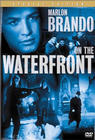
 This movie directed by Elia Kazan holds up even 50 years after its making. Labor unions in America no longer enjoy the power they did after World War II when their struggles with management made the front page of newspapers almost every day. If the movie were made today the corrupt union boss would be replaced by the corrupt Enron manager. But what would remain is the dramatic struggle between the many decent people who are exploited by the few, but don’t seem to be able to overthrow their exploiters until a few muster enough courage to do so. Marlon Brando delivers one of the most moving acting performances I have ever seen.
I did not know until I read his obituary that Brando’s performance in this film was universally agreed to be one of the finest moments in film.
Marlon Brando, Oscar-Winning Actor, Is Dead at 80
July 2, 2004 By RICK LYMAN
Marlon Brando, the rebellious prodigy who electrified a
generation and forever transformed the art of screen acting
but whose obstinacy and eccentricity prevented him from
fully realizing the promise of his early genius, died on
Thursday at a Los Angeles hospital. He was 80.
The cause was pulmonary fibrosis, said Jay Cantor, a family
spokesman.
In the nearly 60 years since Mr. Brando first won acclaim,
on Broadway and then in films, younger audiences came to
know him as a tabloid curiosity, an overweight target for
late-night comics, not as what he once was: a truly
revolutionary presence who strode through American popular
culture like lightning on legs. Certainly among the handful
of enduringly great American film actors - some say the
greatest - he has also been, without question, the most
widely imitated. Virtually all of the finest male stars who
have emerged in the last half-century, from Paul Newman to
Warren Beatty to Robert De Niro to Sean Penn, contain some
echo of Mr. Brando’s paradigm.
Simply put, in film acting, there is before Brando, and
there is after Brando. And they are like different worlds.
Yet, like Orson Welles - another famous prodigy who
battled Hollywood only to balloon into a cartoon version of
his early brilliance - Mr. Brando’s had a legend built on a
surprisingly small number of roles.
There is his epochal Stanley Kowalski in Tennessee
Williams’s “Streetcar Named Desire,” a role he created on
Broadway in 1947, at age 23, and then played on film in
1951. And there is his performance as the fatally noble
Mexican bandit in “Viva Zapata!” in 1952. And then two
crucial roles, as the first in a long line of leather-clad
mixed-up teenagers in “The Wild One” (1953) and in his
Oscar-winning turn as Terry Malloy, the boxer who could
have been a contender, in “On the Waterfront” (1954), which
many consider his finest performance.
After that explosion of creative fire, there followed a
huge gap of years filled with intermittently compelling but
largely unmemorable roles - and more than a few outright
disasters - before a stunning return to form with “The
Godfather” in 1972 and “Last Tango in Paris” in 1973.
Through it all, he was an often combative and moody
iconoclast, a polarizing and enigmatic figure who generally
stayed out of the public eye. On the few occasions when he
seemed to let loose and speak what was really on his
fertile mind, as in a crushing profile by Truman Capote in
The New Yorker in 1957 or in a pair of truly odd
appearances on “Larry King Live” in the mid-1990’s, he got
himself into trouble.
And more often than not, he would express contempt for the
craft of acting. “Acting is the least mysterious of all
crafts,” Mr. Brando once said. “Whenever we want something
from somebody or when we want to hide something or pretend,
we’re acting. Most people do it all day long.”
He described himself as a lazy man, and he was notoriously
lax about learning his lines. “If a studio offered to pay
me as much to sweep the floor as it did to act, I’d sweep
the floor,” he said. “There isn’t anything that pays you as
well as acting while you decide what the hell you’re going
to do with yourself. Who cares about the applause? Do I
need applause to feel good about myself?”
Yet no one was better at finding brilliant touches that
brought a character to life. Many have pointed to a scene
in “On the Waterfront” during which he delicately put on
the dainty lace glove of the young woman he was awkwardly
trying to court, a seemingly unconscious gesture that fills
the moment with heart-breaking vulnerability.
Inhabiting a Part
In preparing for his first film role,
as a paraplegic veteran in “The Men” (1950), he spent weeks
living at a veterans hospital; many of the film’s first
audiences came away perplexed, thinking that he was an
actual war casualty who had been hired to be in the movie.
And for a man who supposedly disdained acting, he could be
extraordinarily eloquent on the subject. “The close-up says
everything,” he once said. “It’s then that an actor’s
learned, rehearsed behavior becomes most obvious to an
audience and chips away, unconsciously, at its experience
of reality. In a close-up, the audience is only inches
away, and your face becomes the stage.”
Jack Nicholson, who co-starred with Mr. Brando in “The
Missouri Breaks,” (1976) and was a friend and neighbor for
many years, termed him “a genius who was the beginning and
end of his own revolution.” In an interview yesterday, he
said: “There’s no one before or since like Marlon Brando.
The gift was enormous and flawless, like Picasso.”
Mr. Nicholson said that Mr. Brando was the reason that he -
and many other actors of his generation - entered the
profession. “I was in high school when I saw `The Wild
One,’ ” Mr. Nicholson said. “He changed my life forever.”
He recalled: “You didn’t rush him. He had a tremendous gift
just in his stillness. He was a paradigm of how to deal
moment to moment in that artificial situation before a
camera.”
Mr. Brando was not the first actor to bring to the screen
the style known as the Method - an internalized acting
technique promulgated in Russia by Konstantin Stanislavski
in the 1920’s and then popularized in New York in the 40’s
by evangelists like Lee Strasberg, Sanford Meisner - and
Stella Adler, Mr. Brando’s beloved teacher. But Mr. Brando
was the first to make clear how truly powerful and
culture-shaking the Method could be, in the right hands.
“His brutish explosions of anger, his displays of vanity
onstage were seen by pretentious and unpretentious
reviewers alike as having an immediacy new to the theater,”
wrote Harold Brodkey in The New Yorker in 1994.
Unsettling the Audience
What made Mr. Brando different
from previous Method actors like Montgomery Clift, Brodkey
wrote, was the way he taunted and unsettled the audience.
(“You could write a whole chapter on the ways he could make
people feel uncomfortable,” said an early acting colleague
quoted by the biographer Peter Manso.)
To American audiences who first saw him in the late 40’s,
what was most apparent about Mr. Brando was that compared
with other actors of the period, he was brooding, muscular
and intense. Detractors called him a slob. He appeared in
tight bluejeans and torn T-shirts, grimy with sweat,
alternately slack-jawed with stupidity and alive with feral
cunning. And he was more openly sexual, in an animal way,
than the actors who immediately preceded him. Often, Mr.
Brando was accused of mumbling his lines, but audiences
watching those early performances today would notice none
of that, so complete has the Brando school of anti-glamour
taken root.
His anti-authoritarian streak was like catnip to the
generation that came of age right after World War II. In
“The Wild One,” Mr. Brando’s reluctantly sensitive biker is
asked by a small-town matron what it is that he’s rebelling
against. “What’ve you got?” he responds. That line, that
attitude, galvanized the emerging postwar youth culture.
The impression given by many of the finest Method actors -
like Mr. Brando and his fellow student James Dean - was
that they needed to act, as a way to purge their inner
demons. Mr. Brando echoed this, saying that a childhood
with remote and alcoholic parents had driven him to
pretending.
“When you are a child who is unwanted or unwelcome, and the
essence of what you are seems to be unacceptable, you look
for an identity that will be acceptable,” he said.
Mr. Brando was born on April 3, 1924 in Omaha. In his 1994
autobiography, “Songs My Mother Taught Me,” he described a
painful childhood. His father, Marlon Brando Sr., was an
abusive alcoholic, he said, who never seemed to find
anything good to say about his only son. His mother,
Dorothy Pennebaker Brando, was also alcoholic, he said,
more interested in drinking than in caring for her family.
The boy was nicknamed Bud to distinguish him from Marlon
Sr.
“I suppose the story of my life is a search for love,” Mr.
Brando said. “But more than that, I have been looking for a
way to repair myself from the damages I suffered early on
and to define my obligation, if I had any, to myself and my
species.”
The young boy suppressing his anger against his father was
seen by Mr. Brando and many critics as the wellspring for
many of his performances. In 1935, his parents separated
and Mr. Brando and his two older sisters, Florence and
Jocelyn, moved with their mother to Orange County, Calif.
Two years later, his parents reconciled, and the family
moved to the northern Chicago suburbs, first to Evanston
and then to Libertyville, where the teenager came of age.
He was an indifferent student, given to pranks. His father
sent him to the Shattuck Military Academy in Minnesota,
from which he was expelled in his senior year for smoking
and insubordination.
There was another battle taking place in the Brando
household, between the values of his father, a middle-class
businessman, and his mother, a disappointed actress. By the
time the boy was kicked out of military school, his sisters
had moved to New York to forge acting careers. Mr. Brando
stayed in Libertyville for a while, then followed his
sisters to New York in 1943. A bad knee exempted him from
the draft.
Studying the Method
In New York, Mr. Brando enrolled in the Dramatic Workshop
of the New School for Social Research. He seemed to
understand the Method instinctively, how to use his own
reservoir of memories and internalized emotions to find
moments of truth. Indeed, some of his fellow students said
that teaching him the technique was redundant.
“Marlon’s going to school to learn the Method was like
sending a tiger to jungle school,” Elaine Stritch once
said.
In a 1997 New York Times article on the 50th anniversary of
the Actors Studio, Ann Douglas described an early acting
exercise: “During one class, Stella Adler, Mr. Brando’s
teacher, told her students to pretend to be chickens on
which an atomic bomb was about to fall. The rest of the
students ran around clucking loudly and looking frantically
at the sky, but Mr. Brando just sat there calmly - he was a
hen, busy laying her eggs. What would a hen know or care
about a bomb?”
He. made his stage debut at the New School, playing Jesus
in a 1944 production of Gerhart Hauptmann’s “Hannele.”
Later that year, he joined the Broadway cast of “I Remember
Mama,” and remained for two years.
In 1946, Mr. Brando appeared in several Plays - “Truckline
Cafe” by Maxwell Anderson, “Candida’` by George Bernard
Shaw, “A Flag Is Born” by Ben Hecht - before a young
director named Elia Kazan recommended him for the role of
Stanley Kowalski in “A Streetcar Named Desire.”
In 1947, in that role, he exploded onto the stage. Although
the play was largely the story of Blanche DuBois, the
quintessentially neurotic Southern belle, played
brilliantly by Jessica Tandy, Mr. Brando was all anyone
could talk about.
The inspiration for Mr. Brando’s costume - torn T-shirt,
extremely tight jeans - came from watching construction
workers at a near the theater, said Lucinda Ballard, the
play’s costume designer. Mr. Brando painstakingly bulked up
his muscles and then had a fitting for the specially made
jeans, insisting that he wear no underwear for the fitting.
“Through his own intense concentration on what he is
thinking or doing at each moment he is on the stage, all
our attention focuses on him,” the critic Harold Clurman
write in 1948.
For three years, he parried offers from Hollywood until
finally he accepted the lead role in “The Men,” drawn by
the character of the bitter and disabled war veteran.
The Hollywood establishment did not quite know what to make
of Mr. Brando. It never did.
In the early 50’s, movie stars were expected to be models
of glamour when they appeared in public. Mr. Brando went
around in T-shirts and bluejeans. He was often spotted
driving down Sunset Boulevard in a convertible wearing a
fake arrow that seemed to penetrate his head.
“Nobody, nothing, no amount of money can make him behave,”
said a 1954 profile in The New York Times Magazine. “He’s
got to be his own master, even though he may not yet have
mastered himself.”
Mr. Brando didn’t seem to care what Hollywood thought of
him. “The only reason I’m here is that I don’t yet have the
moral courage to turn down the money,” he said.
“The Men” was followed in 1951 with the film version of
“Streetcar,” in which Mr. Brando had the same effect on
movie audiences that he’d had on Broadway. Hollywood,
however, kept its distance. Though the film won Oscars for
Vivien Leigh’s Blanche, as well as for supporting
performers, Kim Hunter and Karl Malden, Mr. Brando lost.
In 1952, he starred again for Mr. Kazan in “Viva Zapata!,”
a political paean to revolutionaries with a John Steinbeck
script. Again, a supporting performer, Anthony Quinn, took
home the Oscar and Mr. Brando did not.
In 1953, trying to prove he was more than a mumbling,
one-note performer, Mr. Brando played Marc Antony in a film
of Shakespeare’s “Julius Caesar.” Again, he was nominated
for an Oscar. Again, he lost.
Hollywood’s snubbing of Mr. Brando was getting
embarrassing. Although widely proclaimed by critics as the
greatest actor of his generation and embraced at the box
office in film after film, his disdain for the
establishment was returned in kind.
Finally, in 1954, in “On the Waterfront,” he won his first
Oscar. The role of Terry Malloy, more than any other, is
emblematic of the power and reach of the style of acting
Mr. Brando brought to the screen.
“If there is a better performance by a man in the history
of film, I don’t know what it is,” said Mr. Kazan, his
director again.
Eva Marie Saint, who won an Oscar for best supporting
actress for her role in “On the Waterfront,” said yesterday
that throughout the filming, “Marlon was the guy from the
waterfront and I was the sweet Catholic girl - he was Terry
and I was Edie - and we always kept in character, even when
we had lunch together.”
“When we had to do our scenes,” she said, “it wasn’t like
Marlon and Eva Marie suddenly had to leave their own
personalities.”
She added: “Times were changing in this country. We had
playwrights like Tennessee Williams and Arthur Miller who
needed actors like Marlon who could convey true emotions,
real feelings, get into the skin of characters.”
Hollywood had finally embraced Brando. At the Academy Award
ceremonies, he even joked with the emcee, Bob Hope,
wrestling with him over the Oscar he had just won. It
seemed to presage greater glories but proved to be the end
of the most fertile period in Mr. Brando’s professional
life.
Faltering Steps
To avoid a lawsuit, for walking off a big-budget
extravaganza called “The Egyptian,” Mr. Brando agreed to
play Napoleon in another lavish romance called “Desir


Your Comments
1 Responses. Comments closed for this entry.