

 The internet today is removing barriers between people living in different places. The railroads were one of the technologies (telegraph and telephone were others) that this for 19th century. The Writer’s Almanac reports:
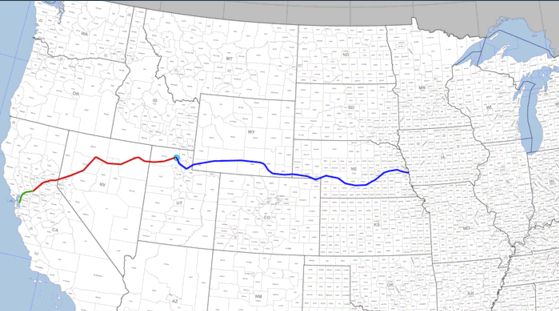
The First Transcontinental Railroad was completed on this date in 1869. The project had been discussed since the 1830’s when Europeans were settling in California in increasing numbers, but people couldn’t decide on the best route. Some argued for a central route through Wyoming and Nebraska, and others felt a southern route through Texas was better because it would avoid the Rocky Mountains. Over time the Pony Express proved that the central route was passable even in winter, and Texas allied itself with the Confederacy in the Civil War, so the central route won out.
The building of a transcontinental railroad was one of Abraham Lincoln’s big goals during his presidency. He signed legislation to construct the line in July 1862, and two companies were hired: Central Pacific would build from west to east, and Union Pacific would build from east to west. The law arranged to pay the companies per mile, and they exploited that provision whenever possible. The main stockholder of Union Pacific, who had been Lincoln’s employer before entering politics, arranged to add extra miles to the track and usually ran it conveniently through land that he owned, so he got paid for that too. When this came to light in 1872, it became one of the major scandals of the 19th century.
It wasn’t just corruption that marred the project. Chinese immigrants did much of the hard and dangerous labor, paid far less than their white counterparts. The railroad route went through Indian lands in violation of government treaties and disrupted their hunting grounds. Once connected to new markets in the east by rail, professional hunters decimated the bison population.
On May 10, 1869 the two companies met up at Promontory Point, Utah amidst great fanfare. When it was finally completed, the journey from New York to Sacramento took about a week—a considerable improvement over the previous travel time of nearly six months.


Your Comments
0 Responses. Comments closed for this entry.