

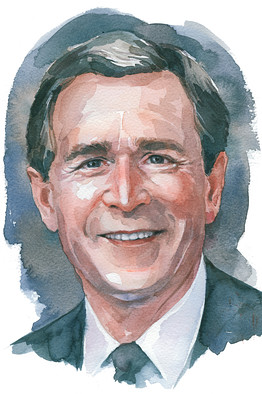
 Kimberly Strassel: I ask the president what he’s learned from his time in office—not from a policy perspective, but as a person. His answer is unsurprising from a man who has always talked openly of his faith—though that, too, has earned him criticism.
“I’ve learned that God is good. All the time.”
PM: Hallelujah. We paid a very heavy price to afford Georgie this personal learning experience. The very fact that Georgie became president is strong evidence that God sometimes does not pay attention. 
Historians will have to call in an army of psychologists to figure Bush’s brain out. Read the full he full Interview in the Wall Street Journal, click on more.
Bush on His Record: The president defends his democracy agenda and his economic interventionism.
By KIMBERLEY A. STRASSEL
Air Force One. As he sits at his mile-high desk, clad in his Air Force One crew jacket, George W. Bush is as he has ever been: upbeat, focused, confident in his past decisions and in the future.
This is remarkable given the up and downs—lately downs—of his administration. Through it all, the president has acted on his own convictions, a trait that has inspired both violent critics and passionate defenders.
In a more than hour-long interview, Mr. Bush tells me about his tenure. He ticks off his personal list of domestic achievements: No Child Left Behind, which he says was not only an “education reform” but a “civil rights measure”; a costly Medicare prescription-drug program, which also created health-savings accounts and put “people in charge of their own health-care decisions”; his faith-based initiative, which he says was not about making the state a “religious recruiter” but about creating a government mentality that says “if it works, fund it”; his tax cut, which he credits in part for “52 months of uninterrupted job growth.” He also is proud of “fighting off protectionism and promoting trade,” and his success at getting Trade Promotion Authority back in 2002.
Mr. Bush had many big plans that never came to fruition, from school vouchers to radical health-care reform. He considers Social Security and immigration the “two big issues that were unfinished.” His immigration plan infuriated his base, which viewed it as amnesty. He remains unrepentant. “Immigration was a very tough issue, and I knew it would be tough because it’s a very emotional issue . . . On the other hand, the system was broken, falling apart, and people’s lives were being affected in a way that was really not worthy of our country.”
He also won’t agree that Social Security reform was a casualty of the Iraq war. “Social Security did not pass because legislative bodies tend to be risk-averse, and restructuring, reforming Social Security requires a certain amount of risk. And the idea of asking members of Congress to deal with a problem that is not imminent is difficult.” He contents himself with having “laid out some solutions” and hoping a future president will take courage from the fact he campaigned on it twice, “proving it was not the third or fourth or fifth rail of American politics.”
He’s confident “there will be a period of time when free-market, conservative supply-siders will study the Bush tax cuts and say the following: One, it helped us recover from a recession; and two, by holding down nondefense discretionary spending, we were on our way to balancing the budget.” That latter part might be a leap for conservatives, whose own remembrances of the Bush spending record include farm bills, earmarks and the president’s reluctance to wield a veto pen.
Yet the president remains adamant his budget troubles were the result of a ramp-up in defense spending. “The problem I had on the budget, in terms of perception, was, one we were at war, and I had pledged to mothers, fathers, spouses, children, that their loved ones would have what it takes . . . I refused to compromise on the military.”
The deficit has exploded partly as a result of the administration’s recent financial interventions. Mr. Bush remains convinced they were necessary to prevent the economy from failing and to “preserve the free-market system.” “I think people will look back at this period in time and say that George W. Bush, when confronted with a significant financial problem, put all chips in.”
Is he concerned that putting all the chips in has potentially laid the groundwork for an unprecedented era of big government? “I worry about some using the excuse of rescuing the economy to undermine free-market principles, whether it be domestically or internationally, I worry that the idea of trying to regulate the markets—which requires some regulation no question—but the danger is overregulation . . . So, yes, I’m concerned.” This is why, he says, he gave his speech on free markets (in New York City on Nov. 13), and one reason he hosted the G-20 meeting in Washington a few days later. “I wanted to make sure that we send a clear message that while there were excesses, we should not destroy markets.”
The action that will always most define the Bush presidency will be the invasion of Iraq. It is also the decision he remains most visibly passionate about, especially given it was the cornerstone of his broader “freedom agenda” in the Middle East. That agenda, he says, is working, and he remains confident that while it “was widely criticized by some as being hopelessly na


Your Comments
0 Responses. Comments closed for this entry.