

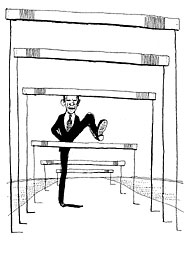
 The money in Washington is on Health Care legislation not passing this year. FRANK RICH is hedging his bets on this issue. But he articulates forcefully that Obama needs to create an overarching narrative before it is too late for his presidency.
WEDNESDAY’S health care rally was one of President Obama’s finest hours. It was so fine it couldn’t be blighted even by his preposterous backdrop, a cohort of white-jacketed medical workers large enough to staff a hospital in one of the daytime soaps that refused to be pre-empted by the White House show.
Obama’s urgent script didn’t need such cheesy theatrics. At last he took ownership of what he called “my proposal,” stating concisely three concrete ways the bill would improve America’s broken health care system. At last he pushed for a majority-rule, up-or-down vote in Congress. At last he conceded that bipartisan agreement between two parties with “honest and substantial differences” on fundamental principles wasn’t happening. At last he mobilized his rhetoric against a villain everyone could hiss—insurance companies. In a brief address, he mentioned these malefactors of great greed 13 times.
There was only one problem. This finest hour arrived hastily and tardily. At 1:45 p.m. Eastern time, who was watching? Of those who did watch or caught up later, how many bought the president’s vow to finish the job “in the next few weeks”? We’ve heard this too many times before. Last May Obama said he would have a bill by late July. In July he said he wanted it “done by the fall.” The White House’s new date for final House action—specified as March 18 by Robert Gibbs, the press secretary—is already in jeopardy.
“They are waiting for us to act,” Obama said on Wednesday of the American people. “They are waiting for us to lead.” Actually, they have given up waiting. Some 80 percent of the country believes that “nothing can be accomplished” in Washington, according to an Ipsos/McClatchy poll conducted a week ago. The percentage is just as high among Democrats, many of whom admire the president but have a sinking sense of disillusionment about his ability to exercise power.
Now that we have finally arrived at the do-or-die moment for Obama’s signature issue, we face the alarming prospect that his presidency could be toast if he doesn’t make good on a year’s worth of false starts. And it won’t even be the opposition’s fault. If too many Democrats in the House defect, health care will be dead. The G.O.P. would be able to argue this fall, not without reason, that the party holding the White House and both houses of Congress cannot govern.
For the sake of argument, let’s say that Obama does eke out his victory. Republicans claim that if he does so by “ramming through” the bill with the Congressional reconciliation process, they will have another winning issue for November. On this, they are wrong. Their problem is not just their own hypocritical record on reconciliation, which they embraced gladly to ram through the budget-busting Bush tax cuts. They’d also have to contend with this country’s congenitally short attention span. Once the health care fight is over and out of sight, it will be out of mind to most Americans. We’ve already forgotten about Afghanistan—until the next bloodbath.
The 2010 election will instead be fought about the economy, as most elections are, especially in a recession whose fallout remains severe. But that battle may be even tougher for this president and his party—and not just because of the unemployment numbers. The leadership shortfall we’ve witnessed during Obama’s yearlong health care march—typified by the missed deadlines, the foggy identification of his priorities, the sometimes abrupt shifts in political tone and strategy—won’t go away once the bill does. This weakness will remain unless and until the president himself corrects it.
Those who are unsympathetic or outright hostile to Obama frame his failures as an attempt to impose “socialism” on a conservative nation. The truth is that the Fox News right would believe this about any Democratic president no matter who he was and what his policies were. Obama, who has expanded the war in Afghanistan and proved reluctant to reverse extra-constitutional Bush-Cheney jurisprudence, is a radical mainly to those who believe a conservative Republican senator like Kay Bailey Hutchison of Texas is a closet commie.
The more serious debate about Obama is being conducted by neutral or sympathetic observers. There are many hypotheses. In Newsweek, Jon Meacham has written about an “inspiration gap.” He sees the professorial president as “sometimes seeming to be running the Brookings Institution, not the country.” In The New Yorker, Ken Auletta has raised the perils of Obama’s overexposure in our fractionalized media. (As if to prove the point, the president was scheduled to appear on Fox’s “America’s Most Wanted” to celebrate its 1,000th episode this weekend.) In the Beltway, the hottest conversations center on the competence of Obama’s team. Washington Post columnists are now dueling over whether Rahm Emanuel is an underutilized genius whose political savvy the president has foolishly ignored—or a bull in the capital china shop who should be replaced before he brings Obama down.
But the buck stops with the president, not his chief of staff. And if there’s one note that runs through many of the theories as to why Obama has disappointed in Year One, it cuts to the heart of what had been his major strength: his ability to communicate a compelling narrative. In the campaign, that narrative, of change and hope, was powerful—both about his own youth, biography and talent, and about a country that had gone wildly off track during the failed presidency of his predecessor. In governing, Obama has yet to find a theme that is remotely as arresting to the majority of Americans who still like him and are desperate for him to succeed.
The problem is not necessarily that Obama is trying to do too much, but that there is no consistent, clear message to unite all that he is trying to do. He has variously argued that health care reform is a moral imperative to protect the uninsured, a long-term fiscal fix for the American economy and an attempt to curb insurers’ abuses. It may be all of these, but between the multitude of motives and the blurriness (until now) of Obama’s own specific must-have provisions, the bill became a mash-up that baffled or defeated those Americans on his side and was easily caricatured as a big-government catastrophe by his adversaries.
Obama prides himself on not being ideological or partisan—of following, as he put it in his first prime-time presidential press conference, a “pragmatic agenda.” But pragmatism is about process, not principle. Pragmatism is hardly a rallying cry for a nation in this much distress, and it’s not a credible or attainable goal in a Washington as dysfunctional as the one Americans watch in real time on cable. Yes, the Bush administration was incompetent, but we need more than a brilliant mediator, manager or technocrat to move us beyond the wreckage it left behind. To galvanize the nation, Obama needs to articulate a substantive belief system that’s built from his bedrock convictions. His presidency cannot be about the cool equanimity and intellectual command of his management style.
That he hasn’t done so can be attributed to his ingrained distrust of appearing partisan or, worse, a knee-jerk “liberal.” That is admirable in intellectual theory, but without a powerful vision to knit together his vision of America’s future, he comes off as a doctrinaire Democrat anyway. His domestic policies, whether on climate change or health care or regulatory reform, are reduced to items on a standard liberal wish list. If F.D.R. or Reagan could distill, coin and convey a credo “nonideological” enough to serve as an umbrella for all their goals and to attract lasting majority coalitions of disparate American constituencies, so can this gifted president.
He cannot wait much longer. The rise in credit-card rates, as well as the drop in consumer confidence, home sales and bank lending, all foretell more suffering ahead for those who don’t work on Wall Street. But on these issues the president, too timid to confront the financial industry backers of his own campaign (or their tribunes in his own administration) and too fearful of sounding like a vulgar partisan populist, has taken to repeating his health care performance.
And so leadership on financial reform, as with health care, has been delegated to bipartisan Congressional negotiators poised to neuter it. The protracted debate that now seems imminent—over whether a consumer protection agency will be in the Fed or outside it—is again about the arcana of process and bureaucratic machinery, not substance. Since Obama offers no overarching narrative of what financial reform might really mean to Americans in their daily lives, Americans understandably assume the reforms will be too compromised or marginal to alter a system that leaves their incomes stagnant (at best) while bailed-out bankers return to partying like it’s 2007. Even an unimpeachable capitalist titan like Warren Buffett, venting in his annual letter to investors last month, sounds more fired up about unregulated derivatives and more outraged about unpunished finance-industry executives than the president does.
This time Obama doesn’t have a year to arrive at his finest hour. Not to put too fine a point on it, but the clock runs out on Nov. 2.
Update: March 14, 2010
As Health Vote Awaits, Future of a Presidency Waits, Too
By PETER BAKER
WASHINGTON—Senator Mitch McConnell, the Republican leader, had a little political advice last week for President Obama and the Democrats: Don’t pass the president’s health care legislation because you would risk losing in the midterm elections.
Mr. Obama laughed about it afterward. “I generally wouldn’t take advice about what’s good for Democrats” from Mr. McConnell, he told an audience in Pennsylvania. But he conceded that “that’s what members of Congress are hearing right now on the cable shows and in sort of the gossip columns in Washington.” He went on to argue that the issue should be what’s right, not the politics.
But this is Washington and politics are never far from the surface, especially at a decisive moment like this. If the schedule being mapped last week holds - and Mr. Obama’s senior adviser, David Axelrod, said on Sunday that it would—the fate of the president’s health care plan should be decided within the week. “I believe we will have” the votes, Mr. Axelrod said on ABC’s “This Week,” though Republicans and even some Democrats have questioned whether the votes are there now.
But the plan’s fate could depend on how a couple dozen Democratic congressmen answer the questions Mr. McConnell and Mr. Obama raised: Would passing health care devastate Democratic chances in the fall? Would rejecting it devastate a Democratic presidency?
Washington is already debating how pivotal the vote will be to his presidency. Mr. Obama has devoted vast energy and political capital over the last 14 months to get to this point, the presidential equivalent of an all-in bet on the poker table. Should he fail to push his plan through a Congress with strong Democratic majorities, it would certainly damage his credibility as a leader for months, and maybe years. Already the fight has scarred Washington, leaving behind a polarized and angry political elite and questions about whether the system is broken.
If Mr. Obama falls short on health care, his hopes of passing other ambitious legislation like an overhaul of immigration and a market-based cap on carbon emissions to curb climate change would seem out of reach, at least for the rest of this year. Much of Washington would question whether he is weak, some Democratic candidates would run away from him and Mr. Obama would be forced to consider a narrower agenda like that pursued by Bill Clinton after his own health care drive collapsed.
At the same time, passing it has its risks too. While a bill-signing ceremony in the Rose Garden would provide at least a short-term boost to a beleaguered president, Republicans have made clear that the legislative procedure Democrats are using to avoid another filibuster would so anger them that they would not cooperate on other major initiatives this year.
“If they jam through health care,” said Senator Lindsey Graham of South Carolina, then Democrats will have “poisoned the well” on other issues. He was interviewed Sunday on ABC’s “This Week.”
An immigration proposal he has been working on with Senator Charles Schumer, Democrat of New York, would likely fall victim to the worsened environment, he said.
If Mr. Obama and the Democrats succeed, the challenge over the next eight months will be to convince the public that the program is better than polls suggest they think it is. And while some of its features would take effect right away, particularly popular limits on abuses by insurance companies, much of its impact in terms of coverage for the uninsured would not kick in until long after the fall election.
“If and when this is passed, Democrats will run aggressively on this,” said Dan Pfeiffer, the White House communications director. “We relish the idea of Republicans running on the Tea Party mantle of repeal.”
But Karl Rove, the former senior adviser to President George W. Bush, said Republicans relish the fight as well. “If they pass it,” he said about the Democrats, “they’re dead in the polls.”
Past presidents have suffered the consequences of big initiatives. Mr. Bush failed to get a Republican Congress to approve his overhaul of Social Security in 2005, undercutting his ability to pass other major proposals for the rest of his term. In hindsight, Mr. Rove said he wished the Bush White House had led off the second term with immigration and chalked up a bipartisan victory before moving on to Social Security.
The more salient precedent remains Mr. Clinton’s health care drive, which ran aground in a Democratic Congress in his first term. The debacle fueled the electoral sweep that handed Congress to the Republicans in 1994. Democrats have bitter memories. “A lot of them have P.T.S.D. from 1994,” said a White House official, referring to post-traumatic stress disorder.
Among those who lost reelection that year was Marjorie Margolies Mezvinsky, a freshman Democrat from Pennsylvania who cast the deciding vote on Mr. Clinton’s budget package, which cut the deficit through spending cuts and a tax increase on the wealthy.
The former congresswoman, who now goes by Marjorie Margolies, recalled last week that she had boiled down her explanation of her vote to four minutes. The problem was that her opponents had boiled down their criticism of her to a 30-second advertisement. “It’s very hard to push back on that 30 seconds and that’s what these members are going to face and that’s what these members are scared about,” she said.
Rahm Emanuel, a former top adviser to Mr. Clinton who now serves as White House chief of staff, has often said Mr. Clinton’s problem was not taking on health care but losing on health care. Unlike Mr. Rove, Mr. McConnell and other Repubicans, Thomas M. Davis III, a former congressman who served in the Republican leadership, said failure to pass health care would be worse for Democrats than passing it.
“If they pass nothing, their base—the college professors, the African-Americans, all the surge voters who put them there, they just walk,” Mr. Davis said. “You don’t want to think about it.” The best option at that point for Mr. Obama, he added, would be to push through a narrower health care bill and argue to the base that at least he tried for the more expansive version.
Still, for all the potential consequences, it is probably too hyperbolic to suggest the presidency rides on this moment. If he fails this week, Mr. Obama could still recover. Even a weakened president has enormous capacity to set an agenda. For all the damage Mr. Clinton absorbed from the failure of his health care plan and the Republican takeover, he eventually found his footing again and won re-election handily.
Of course, he and Mr. Bush both recovered from early troubles in part because of leadership during moments of crisis—Mr. Clinton after the bombing in Oklahoma City in 1995 and Mr. Bush after the attacks of Sept. 11, 2001. That may be harder for Mr. Obama, who inherited crises from the start in the form of two wars and an economic meltdown. The botched Christmas Day bombing suggested that Mr. Obama might face recriminations in case of a new crisis.
But he has the benefit of time and residual personal popularity, not to mention an opposition with its own challenges. “I don’t think this will bring down the Obama presidency,” said Mickey Edwards, a former Republican congressman from Oklahoma. “People understand that there’s a Congress and there are other issues and no matter how much of a hit the Democrats take in the elections this fall, there’s still a lot of things he can do in the next three years.”
The problem for Mr. Obama, Mr. Edwards added, is that he has raised the stakes himself so high. “If he says this is make-or-break and my presidency depends on what the American people think of this issue,” he said, “then he’s putting himself in a bad spot.”


Your Comments
0 Responses. Comments closed for this entry.