

As far as stories goes, this one printed in today’s New York Times is a pretty good one…
Charles Calls End to the Affair: He’ll Happily Wed His Camilla
By SARAH LYALL
LONDON, Feb. 10 - They have been friends for more than 30 years and lovers for most of that time. They have survived marriages to and divorces from other people; the icy disapproval of relatives; the resentment of the public; and, perhaps most excruciating of all, the publication of intimate details of their risqu
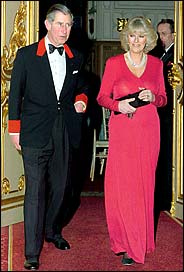 The wedding is to take place on April 8 in a civil ceremony at Windsor Castle, Charles announced on Thursday, but the 57-year-old bride will not become the Princess of Wales - that position having already been more than filled by the prince’s late and much-remembered former wife, Diana. Instead, Mrs. Parker Bowles will be known as Her Royal Highness the Duchess of Cornwall.
Nor will she be crowned queen. In a move that addresses one of the thorniest issues surrounding the marriage, Mrs. Parker Bowles will become the princess consort if Charles, 56, succeeds his mother on the throne. It will be the first time in the history of the English monarchy that such a title has been used, according to Vernon Bogdanor, professor of politics at Oxford University, and the first time an English king’s wife has not been queen. (Queen Victoria did have Albert as prince consort.)
The announcement gives official status for the first time to Mrs. Parker Bowles, who has been living in an uneasy purgatory - part of the prince’s life, but bound by royal custom and social protocol to be an unequal partner. Although in recent years the two have appeared more often together in public, their murky status has put her in a difficult and oddly anachronistic position.
In earlier eras, of course, royals were not allowed to marry divorced people. In 1936, Edward VIII renounced the throne rather than give up Wallis Simpson, a divorced American. In 1955, Prince Charles’s aunt, Princess Margaret, broke off a relationship with a divorced man rather than relinquish her royal status and all its perks.
But in a sign of how much things have changed, this time Queen Elizabeth gave her permission for, and blessing to, the engagement of her divorced son to his divorced lover. Saying that she and her husband, Charles’s father, were “very happy,” she ordered that the Round Tower at Windsor Castle be lit in celebration.
The queen has not always appeared to be Mrs. Parker Bowles’s biggest fan. Although Charles has for some time been openly living with Camilla, his mother has very rarely entertained the two of them as a couple and indeed seemed intent on distancing herself from the relationship. But the two met in 2000, and on Thursday the queen said that “we have given them our warmest good wishes for their future together.”
In their own statement, the prince’s two sons, Prince Harry and Prince William, said, “We are both very happy for our father and Camilla and we wish them all the luck in the future.”
While the majority of respondents in several snap public opinion polls in Britain on Thursday said they disapproved of the engagement, crowds of well-wishers cheered Prince Charles during a public appearance in London, and politicians rushed to congratulate the couple. Even officials of the Church of England, which until 2002 did not even allow divorced people to marry in church, have come around to the idea that Charles and Camilla would be better off married than not. The question has been complicated by the fact that if he becomes king, Charles will also become supreme governor of the church.
The archbishop of Canterbury, the Most Rev. Rowan Williams, said he was pleased at Charles and Camilla’s decision “to take this important step.” After the civil wedding ceremony, he has agreed to lead a service “of prayer and dedication” at St. George’s Chapel in Windsor.
In a world of expendable relationships, where middle-aged men trade in middle-aged women for younger, firmer models as easily as they might dispose of a creaky toaster or last year’s car, the enduring relationship of Charles and Camilla, as the newspapers call them, carries a sweet poignancy for many.
Although in recent years she has had something of an image makeover, appearing more in couture dresses and less in frumpy countrywoman garb, Mrs. Parker Bowles can hardly be called glamorous and does not appear to care. She once called herself “your devoted old bag” in a love letter to Prince Charles.
Even those unable to forgive Charles for cheating on the Princess of Wales can take a certain comfort in knowing that if he had to do it, at least he took the counterintuitive route, choosing someone older, wrinklier and less svelte than his wife.
It has always been clear that Charles and Camilla truly like each other. They share a passion for hunting, fishing and other outdoor sports. They have bawdy senses of humor. More than that, it seems, the fun-loving Camilla is relatively uncomplicated (at least compared with Diana) and has been stolidly supportive of Prince Charles over the years, despite all the angst the relationship has put her through.
The Prince of Wales and Camilla Shand, as she was then, hit it off from the first time they met, at a polo match in 1970. But Charles was something of a playboy, and when he dithered and went abroad with the navy, Camilla married a longtime suitor, Andrew Parker Bowles. The two remained friends with the prince. Mr. Parker Bowles even took on the ludicrously named ceremonial post of Silver Stick in Waiting to the prince, while his wife took another traditional role - that of the prince’s mistress.
Meanwhile, Charles married Lady Diana Spencer, a coltish 19-year-old who captivated the world - but not her husband - with her demure good looks and blue-eyed charisma. The two were spectacularly ill suited for each other and, sunk by rancor and poor behavior on both sides, the marriage fell part.
Although Charles later said he took up again with Camilla only when his marriage broke down, Diana contended that “there were three people in the marriage, so it was quite crowded.” She reportedly called Camilla “the Rottweiler,” while Camilla reportedly referred to her as “that ridiculous creature.”
It was Camilla Charles loved, and when he and Diana divorced in 1996, it seemed that finally the couple could stop sneaking around. But in the national convulsion of grief after Diana’s horrific death from a car accident in Paris in 1997, public opinion turned viciously against Mrs. Parker Bowles. At one point, irate shoppers pelted her with bread rolls in her local grocery store.
It was not until 1999, at a party in Piccadilly, that the two appeared publicly together, an orchestrated event in which Mrs. Parker Bowles walked well behind the prince.
The two were together on Thursday night at a formal dinner in Windsor Palace. In contrast to his first post-engagement appearance with Diana, in which he answered a question about whether he loved her by smirking and saying “whatever ‘love’ means,” Charles seemed positively ebullient this time around.
Flashing her enormous diamond engagement ring, a royal heirloom, Mrs. Parker Bowles had the glow of a teenager at the prom. “I’m just coming down to earth,” she said.
Addendum: One of my favorite writers, Daphne Merkin, added these thoughts.
NYT, March 6, 2005
THE WAY WE LIVE NOW
A Fairy Tale for Grown-Ups
By DAPHNE MERKIN
Who can forget the frenzied public anticipation—not to mention the media blitz—surrounding the photogenic and, as it would turn out, fatally ill-conceived union of Prince Charles and Lady Diana Spencer? That summer in 1981, when a sober Charles wed a certifiably virginal Diana—she looking more like a demure, pretty milkmaid than the attention-craving glamourpuss she would become—I was staying at a writer’s colony in upstate New York. The atmosphere was heavy with literary concerns, and it was definitely not the thing to evince interest in the choreographed nuptials of two silly anachronistic royals. I worried that I would have to forgo the pleasures of watching the ceremonies along with 750 million other viewers when several days before the event I discovered another writer who shared my declasse fascination. The two of us hatched an ornate plan to depart the colony at 5 a.m. on the day of the wedding, having arranged to drive to a town nearby where my friend knew someone with a house and, most important, a TV. While our colleagues back at the colony lingered in their dreams, we settled down to gaze, wide-eyed with vicarious inner-princess gratification, at the regal fantasy, replete with a gilded chariot, unfolding on the small screen.
Fast-forward to the recent announcement of Charles and Camilla Parker Bowles’s plans to marry in April. Smirks. Snickers. Rolling of eyes heavenward. Everyone on both sides of the Atlantic feels free to join in a riot of name calling—started, I might add, years ago by none other than Diana herself, whose snide nickname for her rival was the Rottweiler. The front-page headline of The Daily Star chortled: ‘‘Boring Old Gits to Wed.’’ Brit Hume of Fox News was more than a bit perplexed: ‘‘Well, if you look at a photograph of Diana, you can understand, but this one . . . why? Why her?’’ A man sitting next to me at a dinner party insists that he wants proof that Camilla is a woman. Another man, one of the more discerning among my acquaintance, but also something of an unreconstructed babe watcher, refers to Camilla as a ‘‘wreck.’’ When I demand to know why she is a wreck, it emerges that any woman over 30—which would include this man’s wife and daughter, not to mention my own inexcusably aged self—qualifies as a wreck. ‘‘The guy could have had any woman he wanted,’’ he adds, sounding outraged on behalf of his entire sex that Charles has sunk to such frumpy depths in his choice of a partner.
The fact that none of this is meant seriously is beside the point, for what is stunningly clear is that Charles’s decision to wed a woman he has been extraordinarily attached to since they first met at a polo match in 1970, and whose allure for him goes well beyond any obvious pinup appeal, has profoundly threatened the football-bonding, beer-guzzling, mother-rejecting frat boy in every man. Ours is a culture that is open to all kinds of desires, it seems, except the sort of male longing for a woman that isn’t immediately reducible to its prurient, arm-candy essence. Which is why Charles’s amorous devotion to Camilla, who has the temerity to look her age and not get her teeth capped or keep her waist whittled to Scarlett O’Hara dimensions (and who, by all accounts, is completely at ease with herself notwithstanding), immediately gets translated into an embarrassing spectacle, something that shows him up as a loony wimp and her as a conniving shrew along the Wallis Simpson model.
Of course, you can hardly expect the poignantly belated decision of these two long-in-the-tooth lovebirds to consecrate their relationship to stir up much in the way of wild excitement. Neither of them possesses the requisite qualities to stimulate the contemporary imagination, grown flabby on a diet of Heidi Klum visuals and C.E.O. excess: Camilla is not beautiful or young or, for that matter, thin (enough), and she seems about as far from the habit of televised, heavily mascaraed soul-baring that endeared Diana to her fans as Bishop Berkeley. Meanwhile, the dithering Charles lacks the singleminded vision and vulgarity of purpose that is supposed to go along with being a rich and powerful guy and that so enthralls onlookers about Donald Trump’s various commercial/matrimonial ventures. If anything, he seems a bit too much of a sensitive mama’s boy, forever looking for a lap to crawl into or—and this must be a first in the annals of overheard phone confessions, whether from a prince or a pauper—a tampon he might impersonate. It’s interesting that for all the cultural agitation about the uncrossable communication divide and lack of closeness between the sexes, the impression that Charles conveys of being in touch with his most intimate yearnings, however painfully expressed, hasn’t earned him points with women. Just as the fact that the couple, middle-aged and insufficiently comely as they are, seem, quite evidently, to have the hots for each other, hasn’t persuaded anyone that this match has an erotic dimension far more potent than the one between Charles and the sexy Diana.
It hasn’t helped the couple’s situation, either, that the logistics related to their big day have resulted in one gaffe after another, all eagerly picked up by the British news media to carnivalesque effect, as if we were being asked to consider a pilot for a sitcom to be called ‘‘Charlie and Cami Get Married.’’ The announcement of the impending nuptials came four days before Valentine’s Day, which made for a slim but sweet journalistic peg, but we will never know why the queen, in all her impenetrable imperial wisdom, decided that it was O.K. for her scandal-plagued eldest son to marry his live-in divorced girlfriend this year and not last year, or next. Undoubtedly her eye is on securing the monarchy after her death (she is 78), but her decision seems to be shot through with lingering ambivalence about how best to salvage whatever dignity remains invested in her hapless brood.
First there was the flurry about the venue for the ceremony. By contrast to Charles’s first marriage, when nothing would do but St. Paul’s Cathedral and Kiri Te Kanawa, this time around nothing seems inglorious enough. Windsor Castle was traded down to the Guildhall, with attendant press mutterings about the cost to the public; then there were various edicts from Buckingham Palace about table settings and premarital sleeping arrangements; finally, as if to puncture this particular balloon before it ever gets off the ground, came the announcement that the queen herself would not be attending the ceremony, followed by the news that neither would any of Charles’s siblings. When you add to this various other rumors, including the one circulated in a British tabloid that the Bushes have decided not to entertain the couple in the White House—they are divorced, after all, and who knows how that would play in the heartland—it’s a wonder the pair don’t throw in the monogrammed towel and take off for a chapel in Reno.
Most crucially, though, there is the shadow of Diana, who was everything the wife to be is not. Despite her own celebrity, she remained persistently star-struck, a vulnerable child of divorce who grew up to marry the icon whose poster she had on her bedroom wall, and whose dance partner at the White House was John Travolta. She was obsessed with her image, counted gaudy celebrities like Elton John and Versace among her friends, suffered from bulimia as well as various mood disorders and constantly tried out new hairstyles and wardrobes. In all this she reminded us of who we are, stuck at home watching the E! network, fantasizing about becoming grander and more gorgeous versions of who we are. The fact that she was troubled by larger demons than the specter of her husband’s former flame and that she was enormously skilled at manipulating her own coverage, the question of whether she had anything to offer Charles or whether she was in fact interested in knowing who he was beyond the poster icon—all these issues got lost in the tragedy of her death.
In truth, it’s impossible to approach this occasion with stardust in our eyes, which is where it most importantly differs from marriage No. 1, and is also where it fails to please us in some easy way. Featuring, as it does, a mature and un-Botoxed woman at its center, however, it should speak to us—especially us older women, otherwise known as wrecks—in a fuller, more resonant fashion. The long and resilient history of Charles and Camilla is a testament to the power of soulmates’ love: not love as an escapist fantasy, but love seasoned by mutual understanding and the contrivances of largely illicit passion. (Let’s hope an official seal of commitment won’t put the clamps on their erotic life, as it has been known to.) The infinitely gratifying but tragically pubescent fairy-tale romance of Charles and Diana has been replaced by a romance for grown-ups who seem to have taken each other’s human measure in private, away from the click of cameras. Camilla, who enjoyed the solid and nurturing childhood that neither Charles nor Diana had, seems to be fairly free of psychological baggage. She is the kind of woman who, if she has a problem, as one of her friends has observed, ‘‘rather than go and see a therapist . . . is a lot more likely to go fox hunting, come back, put some rum in her tea and have some scrambled eggs.’’ Whatever liabilities she does come with—children, pets, an ex, a touch of jowls—are out in the open for all to see, not tucked away behind the palace doors, as Diana’s turned out to be.
What this love story suggests to us are the salutary uses of disenchantment, if I may tweak the title of Bruno Bettleheim’s book about fairy tales. It is anti-ageist, anti-looksist and pro-realism. Coming to us, as it does, in less than perfect shape, the tale speaks to the ordinary imperfections and extraordinary hopes that color all our lives. The tragicomedy that is life in the House of Saxe-Coburg Gotha—‘‘the world’s most brilliant soap opera,’’ as The Economist calls it—is finally bringing us an act worth watching. Far from joining in the disparagement, we post-babe types should be gathering on the appointed day to toast the prince and his ‘‘devoted old bag,’’ as she calls herself. Bring on the confetti.
Daphne Merkin, a novelist and critic, is a frequent contributor to the magazine.
And a code from June Thomas in Slate.
...In an age when preposterously coiffed tycoons engage in serial matrimony with ever younger and more beautiful partners, Charles is doing his bit to atone for the sins of rich, middle-aged men everywhere. He’s making an honest woman of his age-appropriate partner, a woman with whom he is well-matched in looks, habits, and hobbies, whom he has known and loved for more than 30 years. Charles’ mistake was to get his weddings out of order: He married his first wife second and his trophy wife first.


Your Comments
0 Responses. Comments closed for this entry.