

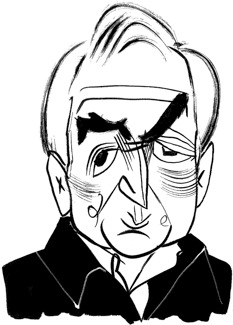
 When I first heard the news about Dominque Strauss-Kahn’s arrest, I thought there was a slim chance that he is innocent. After reading what people who know him well say about his relationship to women, DSK is likely to spend a lot of time in a room far less plush than the Soffitel in Manhattan.
Update July 1: Sensational Reversal of Fortune. Case against DSK close to collapse… Click on More and scroll down for details.
Update August 23: Case against DSK dismissed… Click on More and scroll down for details.
STRAUSS-KAHNIKOV by Philip Gourevitch (New Yorker)
In Paris the other day, a woman arrived late to a lively dinner party, accepted a glass of champagne, and, taking a seat, asked, “So? What are we talking about?” Then she let out a mirthless chuckle to signal that the question was rhetorical. Since Dominique Strauss-Kahn’s arrest in New York on charges (which he has denied) of sexually assaulting an African immigrant hotel maid, there really was no other topic of conversation in the Parisian society that had produced him, particularly among the left-of-center caste of politicians and journalists of which he and his wife, Anne Sinclair, were stars.
Strauss-Kahn, the (now former) chief of the International Monetary Fund, was expected to be the French Socialist Party’s Presidential candidate in next year’s election; and Sinclair, an American-born heiress, was for a long time a host on one of France’s most popular TV news shows. Nearly everyone at the dinner had known them, and it was the handful who knew them best who now spoke most convincingly about his history as an aggressive and incessant groper of women.
According to the stories, he grabbed women in elevators, he cornered them in gardens, and if they resisted he liked to pursue, with phone calls and text messages. Everyone knew, the dinner guests said. For instance, the hostess recalled, there was the time at one of Strauss-Kahn’s homes when he seemed as if he didn’t care who saw him make his moves. Even his wife had to have seen, the hostess said. Surely not, the host said.
Through the windows, the spring evening dimmed to black, and the party moved to the dining room, where the stories continued. Earlier that day at the Cafe de Flore, Pascal Bruckner, the philosopher, had remarked of Strauss-Kahn, “He wasn’t a womanizer—he was sick.” Everyone at the dinner party agreed, and they, too, spoke of Strauss-Kahn in the past tense.
This was a change from the initial reactions to his arrest in France, where the news was greeted mostly with disbelief. A poll conducted the next morning found that nearly sixty per cent of French people thought that Strauss-Kahn was the victim of a conspiracy. Denial had quickly given way to indignation—not at the alleged rapist but at the outrages to which he was subjected by the American criminal-justice system. The French were appalled to see video of Strauss-Kahn’s perp walk in Harlem and photographs of his arraignment: a usually impeccable man appearing unshaven, with his coat collar askew, and his face dark with an exhausted mixture of defiance and defeat.
It is illegal to take and display such photographs in France, where the protection of reputation is considered an extension of the presumption of innocence, just as it is forbidden under the Geneva Conventions to parade or humiliate prisoners of war. (French reporters had no compunction about publishing the name of the alleged victim, a practice held in contempt by American journalists.) But, because Strauss-Kahn was captured and photographed in New York, the French press had pounced on the pictures and made them inescapable.
“It is savage, this photography,” an aide at the French Foreign Ministry, on the Quai d’Orsay, remarked. Then he added, “But if he did what the maid says . . .” The photos had made that “if” real to him: the seriousness of the crime in question, the extent to which the alleged acts were an assault not only on the woman but on the entire system of order and meaning to which a great public servant’s life should be devoted. The I.M.F. chief, he thought, now appeared like a figure from Dostoyevsky: “Strauss-Kahnikov,” he said.
To Pascal Bruckner, the photos showed “the face of a libertine” and “a bulldozer.” Strauss-Kahn had never actually declared his candidacy, and in the past he had been such a lacklustre campaigner that Bruckner suspected that he did not actually want to run. “I think his passion was sex, much more than power,” Bruckner said. “I have many women friends in the Socialist Party who have told me stuff about him. It’s dreadful.” He thought Strauss-Kahn’s friends should have encouraged him to seek psychiatric treatment instead of the Presidency.
Back at the dinner party, guests were engaged in a discussion of eccentric conjugal arrangements, in the course of which the astonishing phrase “wife-swapping Freemasons” was spoken. The host remarked that in a marriage there is often “complicity in pathology.” The guest with the mirthless laugh declared that that was a pretty good description of marriage, period. But everyone agreed that there was a big difference between the charge of violent crime—attempted rape, no less—and the habitual sexual harassment that they had tolerated in Strauss-Kahn. When conversation turned to the French libel laws that inhibit reporting bad behavior, another woman said, “I’m beginning to think all the pictures of Strauss-Kahn in custody were a good thing—maybe they’ll put some fear into men.”
Meanwhile, across town, Dominique de Villepin, the Gaullist former Prime Minister, suggested that the Strauss-Kahn affair ought to put some fear into Socialists: “While they say, ‘We feel betrayed,’ others would say, ‘But you knew and you didn’t say anything.’ ” Now nobody in Paris was talking about anything else. So it was startling to find a politician who preferred to say nothing. The writer Jacques Attali, a former adviser to France’s last Socialist President, and an old friend of Strauss-Kahn’s, said, “I think the best service I can give him is not to speak, not to hear, not to listen, as a kind of moment of mourning”—which was saying a lot.
Strauss-Kahn Case Seen as in Jeopardy
By JIM DWYER, WILLIAM K. RASHBAUM and JOHN ELIGON
This article is by Jim Dwyer, William K. Rashbaum and John Eligon.
The sexual assault case against Dominique Strauss-Kahn is on the verge of collapse as investigators have uncovered major holes in the credibility of the housekeeper who charged that he attacked her in his Manhattan hotel suite in May, according to two well-placed law enforcement officials.
Although forensic tests found unambiguous evidence of a sexual encounter between Mr. Strauss-Kahn, a French politician, and the woman, prosecutors now do not believe much of what the accuser has told them about the circumstances or about herself.
Since her initial allegation on May 14, the accuser has repeatedly lied, one of the law enforcement officials said.
Senior prosecutors met with lawyers for Mr. Strauss-Kahn on Thursday and provided details about their findings, and the parties are discussing whether to dismiss the felony charges. Among the discoveries, one of the officials said, are issues involving the asylum application of the 32-year-old housekeeper, who is Guinean, and possible links to people involved in criminal activities, including drug dealing and money laundering.
Prosecutors and defense lawyers will return to State Supreme Court in Manhattan on Friday morning, when Justice Michael J. Obus is expected to consider easing the extraordinary bail conditions that he imposed on Mr. Strauss-Kahn in the days after he was charged.
Indeed, Mr. Strauss-Kahn could be released on his own recognizance, and freed from house arrest, reflecting the likelihood that the serious charges against him will not be sustained. The district attorney’s office may try to require Mr. Strauss-Kahn to plead guilty to a misdemeanor, but his lawyers are likely to contest such a move.
The revelations are a stunning change of fortune for Mr. Strauss-Kahn, 62, who was considered a strong contender for the French presidency before being accused of sexually assaulting the woman who went to clean his luxury suite at the Sofitel New York.
Prosecutors from the office of the Manhattan district attorney, Cyrus R. Vance Jr., who initially were emphatic about the strength of the case and the account of the victim, plan to tell the judge on Friday that they “have problems with the case” based on what their investigators have discovered, and will disclose more of their findings to the defense. The woman still maintains that she was attacked, the officials said.
“It is a mess, a mess on both sides,” one official said.
According to the two officials, the woman had a phone conversation with an incarcerated man within a day of her encounter with Mr. Strauss-Kahn in which she discussed the possible benefits of pursuing the charges against him. The conversation was recorded.
That man, the investigators learned, had been arrested on charges of possessing 400 pounds of marijuana. He is among a number of individuals who made multiple cash deposits, totaling around $100,000, into the woman’s bank account over the last two years. The deposits were made in Arizona, Georgia, New York and Pennsylvania.
The investigators also learned that she was paying hundreds of dollars every month in phone charges to five companies. The woman had insisted she had only one phone and said she knew nothing about the deposits except that they were made by a man she described as her fiance and his friends.
In addition, one of the officials said, she told investigators that her application for asylum included mention of a previous rape, but there was no such account in the application. She also told them that she had been subjected to genital mutilation, but her account to the investigators differed from what was contained in the asylum application.
A lawyer for the woman, Kenneth Thompson, could not be immediately reached for comment on Thursday evening.
In recent weeks, Mr. Strauss-Kahn’s lawyers, Benjamin Brafman and William W. Taylor III, have made it clear that they would make the credibility of the woman a focus of their case. In a May 25 letter, they said they had uncovered information that would “gravely undermine the credibility” of the accuser.
Still, it was the prosecutor’s investigators who found the information about the woman.
The case involving Mr. Strauss-Kahn has made international headlines and renewed attention on accusations that he had behaved inappropriately toward women in the past, while, more broadly, prompting soul-searching among the French about the treatment of women.
The revelations about the investigators’ findings are likely to buttress the view of Mr. Strauss-Kahn’s supporters, who complained that the American authorities had rushed to judgment in the case.
Some of Mr. Strauss-Kahn’s allies even contended that he had been set up by his political rivals, an assertion that law enforcement authorities said there was no evidence to support.
Mr. Strauss-Kahn resigned from his post as managing director of the International Monetary Fund in the wake of the housekeeper’s accusations and was required to post $1 million bail and a $5 million bond.
He also agreed to remain under 24-hour home confinement while wearing an ankle monitor and providing a security team and an armed guard at the entrance and exit of the building where he was living. The conditions are costing Mr. Strauss-Kahn $250,000 a month.
Prosecutors had sought the restrictive conditions in part by arguing that the case against Mr. Strauss-Kahn was a strong one, citing a number of factors, including the credibility of his accuser, with one prosecutor saying her story was “compelling and unwavering.”
In the weeks after making her accusations, the woman, who arrived in the United States from Guinea in 2002, was described by relatives and friends as an unassuming and hard-working immigrant with a teenage daughter. She had no criminal record, and had been a housekeeper at the Sofitel for a few years, they said.
Mr. Strauss-Kahn was such a pariah in the initial days after the arrest that neighbors of an Upper East Side apartment building objected when he and his wife tried to rent a unit there. He eventually rented a three-story town house on Franklin Street in TriBeCa.
Under the relaxed conditions of bail to be requested on Friday, the district attorney’s office would retain Mr. Strauss-Kahn’s passport but he would be permitted to travel within the United States.
The woman told the authorities that she had gone to Mr. Strauss-Kahn’s suite to clean it and that he emerged naked from the bathroom and attacked her. The formal charges accused him of ripping her pantyhose, trying to rape her and forcing her to perform oral sex; his lawyers say there is no evidence of force and have suggested that any sex was consensual.
After the indictment was filed, Mr. Vance spoke briefly on the courthouse steps addressing hundreds of local and foreign reporters who had been camped out in front of the imposing stone edifice. He characterized the charges as “extremely serious” and said the “evidence supports the commission of nonconsensual forced sexual acts.”
Mr. Strauss-Kahn’s lawyers, Mr. Brafman and Mr. Taylor, declined to comment on Thursday evening.
The case was not scheduled to return to court until July 18.
Strauss-Kahn Drama Ends With Short Final Scene
By JOHN ELIGON (NY Times)
The coda to one of New York’s most gripping and erratic criminal dramas lasted all of 12 minutes.
A prosecutor spoke first, quickly summarizing what had been obvious for weeks: the Manhattan district attorney’s office had little confidence in its case, and even less trust in the accuser it had initially championed. A defense lawyer was next, saying simply, “We do not oppose the motion.”
Then the judge spoke.
And just like that, the sexual-assault case against Dominique Strauss-Kahn was dismissed Tuesday, bringing an abrupt end to what had been a three-month episodic criminal investigation, each chapter offering a sensational twist on the underlying storyline: Mr. Strauss-Kahn, a man of international power and prestige, was accused of sexually assaulting an immigrant hotel housekeeper after she entered his suite to clean it.
The dismissal order issued by Justice Michael J. Obus of State Supreme Court in Manhattan brought some semblance of legal vindication to Mr. Strauss-Kahn, 62, after his stunning and embarrassing arrest more than three months ago. He was taken into custody on May 14 aboard an Air France jet at Kennedy International Airport, and then appeared disheveled and in handcuffs before news cameras.
After the hearing Tuesday, Mr. Strauss-Kahn issued his first statement since his arrest, characterizing the criminal inquiry as “a nightmare for me and my family” and thanking the judge, his own wife, Anne Sinclair, and family and other supporters.
He added, “Finally, we are obviously gratified that the district attorney agreed with my lawyers that this case had to be dismissed,” and said he looked “forward to returning to our home and resuming something of a more normal life.”
One of Mr. Strauss-Kahn’s lawyers, Benjamin Brafman, said he expected his client to go to Washington, where he and his wife have owned a home for several years, to straighten out some personal matters.
“Until today, it was very hard to plan Dominique’s future,” Mr. Brafman said, noting that the prospect of many months of preparation and trial had loomed large. “You can think about what you want to do, but you had the threat of prison hanging over your head.”
For the accuser, Nafissatou Diallo, a 33-year-old Guinean immigrant, the result caps a precipitous fall. Prosecutors initially portrayed her as a credible and powerful witness, but then said that her myriad lies about her past—including a convincing, emotional but ultimately fraudulent account of being gang-raped by soldiers in Guinea—ended up undermining the case.
Ms. Diallo, who has made her identity public, still has a civil suit pending against Mr. Strauss-Kahn for unspecified damages. Her lawyer, Kenneth P. Thompson, has been relentless in his assertion that Mr. Strauss-Kahn forced his client to perform oral sex and that the office of the district attorney, Cyrus R. Vance Jr., should have taken the case to trial.
After the hearing, Mr. Thompson said Mr. Vance “has abandoned an innocent woman and has denied an innocent woman a right to get justice in a rape case.
“And by doing so, he has also abandoned other women who will be raped in the future or sexually assaulted.”
Mr. Thompson made one last attempt to keep the criminal case alive, filing a motion on Monday asking that Mr. Vance’s office be disqualified. But about an hour before Tuesday’s hearing, a court clerk handed out a one-page decision in which Justice Obus denied Mr. Thompson’s motion.
Mr. Thompson appealed the decision, but an appellate judge struck down the appeal Tuesday afternoon, clearing the way for Mr. Strauss-Kahn, the former managing director of the International Monetary Fund, to return to France, though his lawyers said he would not head there immediately.
Mr. Vance has faced criticism from some black civic leaders and women’s rights groups, some of whom protested outside the courthouse Tuesday morning. To them, the case represented an instance of a powerful, wealthy man getting away with something he did to a poor immigrant woman. They argued that Ms. Diallo’s credibility problems should not have prevented Mr. Vance from allowing a jury to decide whether it believed her.
On Tuesday, Mr. Vance released a statement saying that his office was committed to protecting victims of sex crimes, even ones with “imperfect pasts.”
“If we are convinced they are truthful about the crimes committed against them, and will tell the truth at trial, we will ask a jury to consider their testimony to prove a crime,” the statement said. “If we are not convinced, we cannot, should not and do not take the case to a jury.”
(Mr. Vance had planned a news conference in his office to answer questions, but shortly after he took to the podium, earthquake tremors were felt and the room was evacuated. Mr. Vance smiled and said to a member of his security detail, who was hurrying him out: “I’m O.K. O.K. O.K. I’ve been through earthquakes in Seattle all the time.”)
Mr. Vance has sought to allay criticism of his decision through a 25-page report that his office filed with the court on Monday and through statements made by the lead prosecutor on the case, Joan Illuzzi-Orbon, on Tuesday.
The prosecution’s original report was about three times as long, but it was scaled back to provide only the details relevant to support the legal arguments and to spare Ms. Diallo embarrassment, a law enforcement official briefed on the case said.
“At the time of the indictment, all available evidence satisfied us that the complainant was reliable,” Ms. Illuzzi-Orbon told Justice Obus. “But the evidence gathered in our post-indictment investigation severely undermined her reliability as a witness in this case, to the point where we are no longer able to credit her version of events beyond a reasonable doubt.”
Before that, Ms. Illuzzi-Orbon said the case “rises and falls” on Ms. Diallo’s testimony because the physical evidence was not conclusive of a sexual assault and she was the only witness.
One of the more devastating instances in which Ms. Diallo lied came after prosecutors confronted her about where she went after the alleged attack, Ms. Illuzzi-Orbon said. Prosecutors disputed her account with independent evidence, Ms. Illuzzi-Orbon said, and she responded by denying that she had told them that.
“With three prosecutors, an investigator and a translator hanging on her every word, she said she never told us something that everyone in the room heard,” Ms. Illuzzi-Orbon said. She added that prosecutors could not resolve the question of whether what happened between Mr. Strauss-Kahn and Ms. Diallo was criminal.
But Mr. Strauss-Kahn’s team took the district attorney’s actions to mean something else.
“Today the district attorney has told the court that it does not believe he is guilty,” William W. Taylor III, one of Mr. Strauss-Kahn’s lawyers, said in front of the courthouse. “What a turnaround. What a remarkable change in the life of a criminal case, and what a remarkable event, what a tragedy in the life of Dominique Strauss-Kahn.”
While he commended prosecutors for investigating and ultimately dismissing the case, Mr. Taylor said, “There was a collective rush to judgment, not only by law enforcement, but also by the media.”
Mr. Brafman added: “You can engage in inappropriate behavior, perhaps. But that is much different than a crime.”
Still, the court of public opinion may not be on Mr. Strauss-Kahn’s side. Amid a maze of metal barricades and news cameras, protesters outside the courthouse chanted slogans like “D.S.K., shame on you!” and “Whatever we wear, wherever we go, yes means yes, no means no!”
Colin Moynihan, William K. Rashbaum and Noah Rosenberg contributed reporting.
Original Document: Motion to Dismiss Indictment
Update 13. October 2011: Strauss-Kahn Is Not Charged in French Case
By STEVEN ERLANGER and MAIA de la BAUME (NY Times)
PARIS—For the second time this year, legal officials chose on Thursday not to prosecute Dominique Strauss-Kahn on charges of attempted rape, despite what investigators here said was evidence of sexual assault, ending months of scandal that have tarnished a political career that once seemed destined to lead to the French presidency.
There was evidence from Mr. Strauss-Kahn’s own testimony of sexual assault in a 2003 encounter with a French writer and novelist, Tristane Banon, the prosecutor said in a statement, but given a three-year statute of limitations on that charge, no case would be brought.
“Facts that could be qualified as sexual assault have been acknowledged,” the statement said. It did not offer any further details.
Given the age of the case and the difficulty of finding physical evidence so long after the event, it appeared that prosecutors had little choice.
The decision provoked some controversy here, particularly in feminist circles, but nothing like the storms that surrounded this summer’s case in New York involving Mr. Strauss-Kahn and a hotel housekeeper. In the New York case, criminal charges of attempted rape were dropped in August because of doubts about the credibility of his accuser, Nafissatou Diallo, who had lied to prosecutors about aspects of her background and personal life.
Mr. Strauss-Kahn had no immediate comment. One of his lawyers, Henri Leclerc, said in an interview that while Mr. Strauss-Kahn did admit to making advances toward Ms. Banon and kissing her without consent, “no violence was acknowledged.” Another of his lawyers, Frederique Beaulieu, said on television that her client had been “totally cleared.”
Ms. Banon’s lawyer, David Koubbi, issued a statement calling Mr. Strauss-Kahn an “untried sexual aggressor.” The prosecutors established “without reserve that the case is not empty and what she denounced is not imaginary,” Mr. Koubbi said. The finding of the prosecutors “will allow him to escape criminal conviction, but not a legitimate suspicion about his behavior towards women.”
In a nationally televised interview on Sept. 18, Mr. Strauss-Kahn accused Ms. Diallo of lying about their encounter, which he said was consensual. He accused Ms. Banon of lying, too, when she said that he forcefully kissed her, stripped off her top and bra, undid her jeans and shoved his hand into her underwear. He called Ms. Banon’s charges “imaginary” and said he would sue her for defamation.
But later, he told the police that he had made advances toward Ms. Banon and tried to kiss her, but said he had let her go when she rejected him. His lawyers said that such an admission did not qualify as sexual assault.
In some sense, Mr. Strauss-Kahn, 62, appears to be lucky. But he has been personally chastened and humiliated in a very public fashion, and his political career has been derailed by the charges.
Arriving in New York last May, then the managing director of the International Monetary Fund, highly respected for his handling of the early stages of the euro crisis, Mr. Strauss-Kahn was considered nearly a shoo-in as the Socialist Party’s presidential candidate in next spring’s race against the incumbent, Nicolas Sarkozy. Mr. Strauss-Kahn was about to announce his well-planned candidacy, and he was considered very likely to become the next president of France.
But on Sunday, an unshaven Mr. Strauss-Kahn, looking tired and old, cast his vote in the first round of the Socialist Party primary for his ally, Martine Aubry, who is running only because he could not.
Since his return to France in August, after the New York charges were dropped, Mr. Strauss-Kahn has largely kept out of sight, except for the television interview, when he was questioned by a journalist who is a close friend of his wife, Anne Sinclair. Then, he admitted to an “error” and “a moral failing” in the hotel room encounter with the housekeeper, Ms. Diallo, but insisted that no force had been used.
“I think it was a moral failing, and I’m not proud of it,” he said then. “It was a failing, a failing vis-a-vis my wife, my children and my friends, but also a failing vis-a-vis the French people, who had vested their hopes for change in me.”
He said: “I am not proud of it. I regret it infinitely. I have regretted it every day for the past four months, and I think I’m not done regretting it.”
But in a strange choice of words, Mr. Strauss-Kahn also said that he had lost forever his “legerete” in his relations with women and toward life itself. The word, which can mean “lightness,” also means flippancy and irresponsibility.
Asked about his reputation as an aggressive womanizer, or “dragueur,” he said: “I have respect for women, I understand their reaction, I understand they are shocked. I paid heavily, I’m still paying.”
He may pay still more. While his wife, the American-born daughter of a wealthy art dealer, is extremely rich, Mr. Strauss-Kahn is facing one and possibly two civil suits, one brought by Ms. Diallo in New York and one that is expected to be brought by Ms. Banon.
Ms. Diallo’s lawyer, Kenneth P. Thompson, suggested that the French prosecutors were influenced by the decision by the Manhattan district attorney, Cyrus R. Vance Jr., to drop his case.
“The prosecutors in Paris must have felt emboldened by the failure of the Manhattan District Attorney to hold Mr. Strauss-Kahn accountable for his actions here in New York, which we look forward to doing in our civil case,” Mr. Thompson said in an e-mail.
There was little chance Mr. Strauss-Kahn would have been convicted in the French criminal case or served time in jail, but his political career has been badly damaged by the charges, and the French seem almost bored now with him and the case.
“The sword of Damocles has been lifted” from him in terms of prosecution, said Bruno Jeudy, the political editor of Le Journal du Dimanche, a weekly newspaper. “Will it change anything? No, not in the immediate future.”
Mr. Strauss-Kahn “is out of the political film,” Mr. Jeudy said, describing the television interview as a kind of funeral. “We would need very serious economic trouble to request his help.” As for ordinary people, he said, “the French feel very far from this now” and ambivalent about Ms. Banon, now 32, who has garnered a lot of publicity and has just published a book, “The Hypocrites’ Ball,” describing her experiences with Mr. Strauss-Kahn and afterward.
The two cases did bring a strong feminist reaction in France, however, with women’s groups citing renewed interest in their work and new understanding, especially among younger men and women, of the line between flirting and sexual aggression.
Olivia Cattan, president of Paroles de Femmes, a feminist group, said Thursday that the French prosecutor’s decision “leaves a bitter taste” but “is half a victory,” given that “they acknowledge the crime” even if the limits of the law prevent punishment. The case proves that Ms. Banon “is not a liar,” she said.
Since 2006, she said, her group has been pressing for an extension of the statute of limitations for sexual assault from 3 years to 10, as currently the case with rape, which she said required evidence of penetration. “This case is symbolic enough to make it work,” she said.
William K. Rashbaum contributed reporting from New York.


Your Comments
0 Responses. Comments closed for this entry.