

 It can be dauntingly difficult to be rich. Here is another chapter in the humilations rich people can experience from their nouveau riche imitators.
Rich vs. Richer In Palm Beach, The Old Money
Isn’t Having a Ball
Influx of New Wealth Sparks Spat Over Red Cross Event;
Inheritance’s Smaller Role
A 1930s Landmark Is Razed
By ROBERT FRANK
Staff Reporter of THE WALL STREET JOURNAL
May 20, 2005; Page A1
PALM BEACH, Fla.—For nearly a half-century, the Red Cross Ball was the most prestigious party for old Palm Beach society. Then Simon Fireman took over.
The black-tie ball, founded by the late cereal heiress and society queen Marjorie Merriweather Post, brought together the island’s upper-crust families to drink, dance and donate money at the famed Breakers resort. Foreign ambassadors flew in from Washington every year, as well as occasional royalty from Europe.
This year, Mr. Fireman, a Massachusetts native who made a fortune from inflatable pool toys, pledged $750,000 to the local Red Cross and was named ball chairman. The Palm Beach newcomer moved the party from the Breakers to Donald Trump’s flashy Mar-a-Lago club. Regis Philbin came, along with hundreds of out-of-town friends of Mr. Fireman. During his speech, Mr. Fireman boasted that he raised more money and had more foreign ambassadors attending than previous balls.
Many of Palm Beach’s top socialites boycotted the event, going instead to the Breakers for a competing ball that benefited the International Center for Missing and Exploited Children.
“People here are worried that they now have to deal with a powerful force,” says Mr. Fireman, sipping a scotch with ice near the pool at Mar-a-Lago on a recent afternoon. Says Diana Ecclestone, the ball’s previous chairwoman: “Mr. Fireman’s behavior isn’t what most people in Palm Beach are willing to tolerate.”
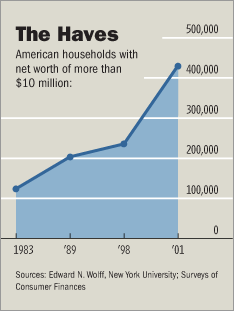
The battle of the balls highlights an escalating tug-of-war between old and new money that’s playing out in traditional blue-blood communities around the country. The number of superwealthy in the U.S. has surged, with 430,000 households now worth more than $10 million. That’s up from 65,000, adjusted for inflation, in 1989. In 2001, the top 1% of Americans ranked by net worth controlled 33% of all personal assets. As the nouveaux riches buy their way into high society, they’re increasingly clashing with an older elite that largely lives off inherited money.
A study of the Forbes 400 list of super-rich Americans by Arthur Kennickell, senior economist with the Federal Reserve in Washington, D.C., found that about half the people on the 2001 list weren’t on the list in 1989. For the nation’s richest 1%, inherited wealth accounted for only 9% of their net worth in 2001, down from 23% in 1989, according to a study by New York University economist Edward Wolff.
The rapid shift in the composition of the tiny sliver of wealthiest Americans is striking because the amount of U.S. class mobility overall hasn’t significantly changed for the last three decades, according to economists. The chance that a poor child will make it into the upper-middle class—or that a rich child will fall down to the middle class—has stayed about the same, and some studies suggest mobility in the U.S. is less than in continental Europe and Canada.
It’s not that the old rich have become appreciably poorer, although taxes, inflation and offspring take their toll. Rather, the new wealth among entrepreneurs has leapfrogged inherited money. Bill Gates’s $48 billion net worth is more than twice the Rockefeller family’s current fortune.
The influx of new money has touched off disputes over values and status in places like Palm Beach, the winter playground for the rich founded by oil magnate Henry Flagler in the 1890s. The 13-mile-long barrier island’s earliest residents—Vanderbilts, Carnegies and Phippses—were upstarts challenging the shipping and trading fortunes of Europe. In the century that followed, however, pedigree was paramount. Even the island’s famous scandals, like the 1983 divorce trial of newspaper heiress Roxanne Pulitzer, involved blue-blood names.
In recent years, more Latin Americans, Asians and Russians have moved to Palm Beach. The town, formerly a haven for retirees and vacationers, has attracted entrepreneurs who run their companies at poolside and type on their BlackBerries at charity balls. “I don’t even golf,” says George Cloutier, owner of a management-consulting firm that he runs from his new beachside mansion.
The cost of living on Palm Beach has soared, pricing out many old families. Top homes are now selling for $20 million to $30 million. The streets are clogged with Bentley GTs and Rolls-Royce Phantoms, replacing the Volvos and Volkswagens favored by old money. Many of Palm Beach’s founding families have died off or moved out. Dina Merrill, the daughter of Red Cross ball founder Ms. Post, now stays in a condominium apartment near the Breakers. The family sold its legendary estate, Mar-a-Lago, in 1985 to Mr. Trump, who turned it into a country club.
Today’s Palm Beach boldfaced names include Sydell Miller, the co-founder of the Matrix line of hair products now owned by L’Or


Your Comments
0 Responses. Comments closed for this entry.