

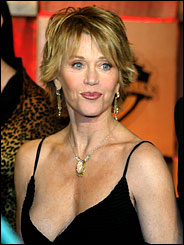
 MAUREEN DOWD has written a funny review of Jane Fonda’s autobiography in today’s NYT.
‘My Life So Far’: The Roles of a Lifetime
One day when she was playing cowgirl in the annual bison roundup on one of the New Mexico ranches of her husband, Ted Turner, Jane Fonda realized with a jolt that she was about to turn 60. She decided that the best way to meet this unnerving milestone was to make a short video of her life ‘‘to discover its different themes.’‘
She invited her daughter, Vanessa Vadim, a documentary filmmaker, to help her. ‘‘Why don’t you just get a chameleon and let it crawl across the screen?’’ Vanessa suggested dryly.
‘‘Ouch,’’ Jane writes. ‘‘This was the rap on me: I’ve had so many personae over my lifetime that it’s easy to think, Who is she, anyway? Is there a ‘there there’? . . . When I looked at photos of myself over the years and matched them up with my husband of the time, I couldn’t help feeling that maybe it was true—maybe I simply become whatever the man I am with wants me to be: ‘sex kitten,’ ‘controversial activist,’ ‘ladylike wife on the arm of corporate mogul.’ . . . Was I just a chameleon, and if so, how was it that a seemingly strong woman could so thoroughly and repeatedly lose herself? Or had I really lost myself?’‘
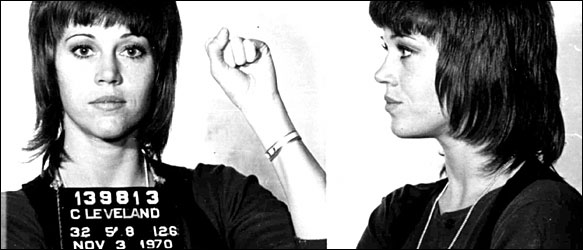
Fonda offers six decades’ worth of exhaustive excavations into her lost and found selves. ‘‘My Life So Far’’ is not a lyrical title, but it captures Jungian Jane’s Sisyphean, Oprahphean struggle to process her pain and banish her demons. Her book is a psychobabble loop of ‘‘tectonic shifting,’’ forfeiting her authenticity and feeling disembodied, then trying to reinhabit her body and ‘‘own’’ her womanhood and her space and her vagina, her leadership and her wrinkles and her mother, so that her ‘‘authentic self’’ can emerge; if the ‘‘functioning self’’ and ‘‘embodied self’’ could merge, she could fully engage with another fully authentic person in mutual affirmation, a whole being not overlapping into another being in a ‘‘relational dance of patriarchy,’’ and live happily ever after in a ‘‘shrinking, congested planet with diminishing resources and no vast, conquerable frontier to escape and expand into.’‘
And certainly no more of those tawdry threesomes!
Her odyssey of self-discovery, with trendy incarnations from Parisian Barbarella to L.A. aerobics queen to born-again Georgian, leads to stilted and earnest pronouncements like: ‘‘Sustainability in a relationship is as critical as it is in the environment.’‘
And: ‘‘The subtle power of sexist roles and their inherent inequality has been deeply imprinted in all of us raised under them.’’ And this about finding God: ‘‘It was more an experiencing of His presence, a psychic lucidity, that was allowing me access to something beyond consciousness. It wasn’t long, however, before I found myself bumping up against certain literal, patriarchal aspects of Christian orthodoxy that I found difficult to embrace.’’ Duh.
At first you think how much more readable her book would be if an editor had chopped out large chunks of ponderous psychic burrowing. But then you realize it all has to be in there, in her own voice. Otherwise, you wouldn’t appreciate what a broken doll Jane Fonda is, how achingly poignant her story is and how much she’s accomplished despite hideously dysfunctional parents who left her unable to comprehend or savor how smart and talented and pretty she was.
Hollywood poured acid on her ego. In her first movie, ‘‘Tall Story,’’ Jack Warner, the head of the studio, made her wear falsies, and the director, Joshua Logan, a family friend, suggested she consider having her jaw broken and reset and her back teeth pulled to create ‘‘a more chiseled look.’‘
The vulnerable, yearning honesty that has made her such a powerful actress in Oscar-winning roles in ‘‘Klute’’ and ‘‘Coming Home’’ breaks through the therapy jargon. Her unrequited love story with her cold and brooding father, a man disgusted by displays of emotion or weakness, is Greek drama. She says she was trapped playing Athena to his Zeus. John McCain’s heart might melt, and he might forgive Fonda her awful Hanoi Jane foolishness, if he were to read the portrait of this lonely little girl in pigtails who grew up in a ‘‘Charles Addams-y’’ house in Greenwich, Conn., eating spinach and Spam, with no warmth or attention from a manic-depressive mother and a repressed father who flew into ‘‘Protestant rages’’ and ignored his children in favor of his acting career and serial wives.
At 9, she tried to share her dad’s interest in reading: ‘‘I got the novel ‘Black Beauty’ and sat in a chair opposite him. He hadn’t acknowledged my presence, but when I came to a passage that made me want to laugh, instead of stifling the laughter I encouraged it, hoping he’d ask me to share with him what was so funny. But he never looked up or said anything. It was as though I weren’t even there.’‘
Her mother is an eerie, spectral figure, a sexy New York sophisticate who had been sexually abused as a child by the piano tuner; she disintegrates before her daughter’s eyes, collecting and mounting butterflies or showing terrified Jane her botched breast surgery, leaving the confused little girl with the impression that it was her mother’s fault that her dad was never around. ‘‘I think it was around that time, maybe right there on that bed, that I vowed I would do whatever it took to be perfect so that a man would love me,’’ Fonda writes.
After Henry Fonda asks for a divorce, her mother ends up in a straitjacket in an institution, coming home only to surreptitiously snatch a hidden razor she will use to slit her throat. On that day, her dad visits Connecticut long enough to sit 12-year-old Jane on his lap, tell her that her mother has died of a heart attack, arrange for a cremation and then return to New York to star in ‘‘Mister Roberts’’ that night. ‘‘Didn’t miss a beat,’’ Fonda writes.
With no one to talk to about her budding sexuality, Jane grew paranoid over the years that she was a boy in a girl’s body. Failing to get her father’s attention, she simply tried to inhabit him—and perhaps one-up him. Henry Fonda was famous for characters who fought for social justice in ‘‘12 Angry Men,’’ ‘‘The Ox-Bow Incident,’’ ‘‘Young Mr. Lincoln’’ and ‘‘Clarence Darrow,’’ so Jane Fonda wanted to be famous for it in real life. But even that backfired with her father, who scorned her activism and stopped speaking to her at times. ‘‘I realized that if I wanted his attention, disapproval was the best I could hope for,’’ she writes. Besides, she was on the road so much, she ended up becoming an absentee parent just like her own. (In Jane jargon, she had a hard time breaking ‘‘that cycle of disconnect.’‘)
She calls the chapter about her father dying ‘‘Closure,’’ but she should have called it ‘‘Gaping Wounds.’’ When she reports some bit of paternal iciness, her pain jitters off the page: ‘‘Dad could spend hours stitching a needlepoint pattern he had designed or doing macrame baskets. . . . But to me, Dad was not a gentle person. He could be gentle with people he didn’t know, utter strangers. Often I run into people who describe finding themselves sitting next to him on trans-Atlantic flights and go on about what an open person he was, how they drank and talked with him ‘for eight hours nonstop.’ It makes me angry. I never talked to him for 30 minutes nonstop!’‘
She says the only time her father referred to her looks was when he would send his wife to tell teenage Jane to wear a less revealing bathing suit or a looser belt; once she overheard him say her legs were too heavy. ‘‘I went to bed and slept for two days, the only way I knew to escape those words that haunted me for the rest of my life,’’ she writes. Hating her body and face, she turned to anorexia, Dexedrine, diuretics and bulimia, calling purging ‘‘somewhat orgasmic.’‘
Fonda offers fair and fascinating portraits of her three husbands.
The French director Roger Vadim was a charming rogue, a compulsive gambler who ran through much of her inheritance from her mother. He turned Jane into Barbarella and denounced jealousy as ‘‘bourgeois.’‘
‘‘Then one night he brought home a beautiful red-haired woman and took her into our bed with me,’’ the author writes. ‘‘She was a high-class call girl employed by the well-known Madame Claude. It never occurred to me to object. I took my cues from him and threw myself into the threesome with the skill and enthusiasm of the actress that I am. . . . Sometimes there were three of us, sometimes more. Sometimes it was even I who did the soliciting.’’ The next morning, after Vadim had left, she would have coffee with the women as ‘‘an antidote to objectification.’‘
Vadim, she says, ‘‘knew how to validate only my facade.’’ She went into her radical chic phase, learning about black voting rights from Marlon Brando and the Vietnam War under the tutelage of Simone Signoret. ‘‘Never underestimate what might be lying dormant beneath the surface of a back-combed blonde wearing false eyelashes,’’ she writes.
After a ‘‘deep hair epiphany,’’ she traded the blond mane for a brown shag and minis for jeans and jetted off to New Delhi on a solo search for inner truth—even though she knew by leaving that she was not ‘‘countenancing the personhood of my baby.’’ By the time she got back to the Beverly Wilshire, she was ‘‘Jane of Arc,’’ as Vadim mockingly called her. Looking out the hotel window, she wondered, ‘‘How could we live this way when there were New Delhis in the world?’‘
She divorced Vadim, sold her Biedermeier antiques and set up an apartment in downtown Los Angeles with her baby, wooden cable spools for tables, mattresses on the floor and beanbag chairs from the Salvation Army.
She admits she was often humorless and defensive when she was working on her ‘‘expanding consciousness as an activist’’ and confesses that as she watched her old taped interviews with her son, Troy, she wanted to shout, ‘‘Will someone please tell her to shut up?’‘
She and Troy’s father, Tom Hayden, met, not cute but causey. Having finished a book about how the Vietnam War paralleled American ‘‘genocide’’ against Native Americans, he showed up at a slide show she had given about Vietnam. He was wearing a long braid and ‘‘rubber sandals of the type I’d been told the Vietnamese made out of the tires of abandoned U.S. vehicles,’’ and asked her for help with an art exhibit designed ‘‘to show the Vietnamese as human beings.’’ Within days, they were making love on the living room floor.
He tutored her on the Pentagon Papers and persuaded her to visit Hanoi, but did not go with the well-meaning but na

Your Comments
0 Responses. Comments closed for this entry.