

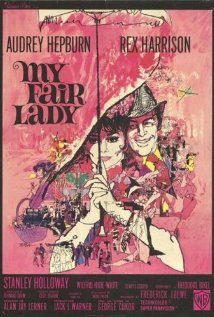
 George Cukor, the director of this extraordinarily fun film, admitted: Give me a good script, and I’ll be a hundred times better as a director. My Fair Lady is based on the play Pygmalion: A Romance in Five Acts by the Irish writer George Bernard Shaw. The writer won the Nobel Prize in literature (1925) and later an Oscar for the film version of Pygmalion (1938). Shaw, who was also the co-founder of the London School of Economics, delivered to Cukor great material about a low class girl (Eliza Doolittle) and a professor (Higgins) who takes a wager that he can turn the impulsive, crude, uneducated flower girl into a lady. The professor’s goal is to use his scientific expertise in how people learn to speak language properly to teach Eliza and pass her off as an aristocrat at the Queen’s ball six months later.
Everything about the film is perfect. It represents Hollywood at its best. I don’t see how the remake of the film planned for 2012 can top the 1964 production.
Shaw in his lifetime did not approve a musical version of his play. In this case, we are all lucky that human life is finite. Once Shaw was dead, first a Broadway musical was produced and then this film staring Rex Harrison and Audrey Hepburn in the leading role came out. Jack Warner, the head of Warner studios, fell in love with the musical and outbid all other suitors, buying the film rights for an unprecedented $5.5 million (this would be $38 million in today’s money). He spent another 6.5 million ($45 million today’s money) to make the film, hiring the best that he could find. Warner allegedly had many mistresses. I suspect that none could match My Fair Lady. He spared no money and effort to make the film perfect. My Fair Lady cleaned up at the Oscars in 1964, winning 8 Oscars. Jack Warner received the Oscar for best picture. I would have given the film even one more Oscar for best actress: Audrey Hepburn’s acting is superlative. Yet because her singing was dubbed, she was passed over for the Oscar. Watching the film is so much fun that you often want to start dancing yourself when actors start singing. One of my favorite scenes is when the father of the heroine visits a bar early in the morning and tries to drink and sing himself ready for getting married to his long-term girlfriend. I suspect that even Shaw would have liked the musical production of My Fair Lady because the librettist, Alan Lerner, used many parts of Shaw’s dialogue unchanged. I am sure, however, that Shaw would hot have approved of the happy ending chosen for the film. In the afterword to the play, Shaw made it quite clear that Eliza could not marry her teacher and instead will marry Freddy. But the sociological and psychological rationales Shaw offers for his preferred ending strike me as equally un-compelling as the ending of the film where Eliza simply returns to Higgins. In real life what happens to two people cannot be predicted. The ideal ending would have been to leave things ambiguous. We simply don’t know what will happen to Eliza and Professor Higgins.


Your Comments
0 Responses. Comments closed for this entry.