

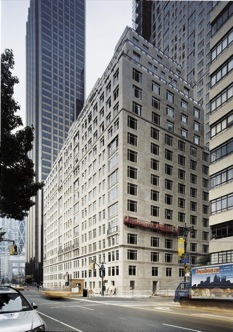
 It was always clear that me that with a lot of money New York City would be even a more spectacular place to live. I accepted with buddhist equanimity my low position in the money hierarchy until I read this review of the new building at 15 Central Park West. Should I have tried to become a rock star or a Wall Street Mogul so that I could have moved into this splendid building?
In an essay titled “The Plight of the Prosperous,” published in 1950 in this magazine, Lewis Mumford dismissed the living accommodations of upscale New Yorkers as little better than slums. “I sometimes wonder what self-hypnosis has led the well-to-do citizens of New York, for the last seventy-five years, to accept the quarters that are offered them with the idea that they are doing well by themselves,” he wrote.
The typical Upper East Side apartment, he said, was dark, airless, and badly laid out. Mumford was mostly right, but, by the time he was writing, design and construction standards were heading downhill so fast that the prewar buildings he was sneering at had come to evoke the grand living of a bygone era.
Today, if you want such luxuries as high ceilings and a dining room, an old building is pretty much the only place to find them. Forget Richard Meier and Jean Nouvel and their sleek glass condominiums: for connoisseurs of Manhattan apartments, the real celebrity architects have always been Rosario Candela, J. E. R. Carpenter, and Emery Roth, who designed the best buildings put up between the wars. That period—when Roth built the San Remo, on Central Park West, while Candela produced the sombre citadels of 740 Park Avenue and 834, 960, and 1040 Fifth Avenue—ended up being the glory years. Such buildings still represent the apogee of New York residential design. Brokers often mention Candela in their ads, because people will pay a premium to live in one of his buildings.
Candela has been dead for more than fifty years, but he should get at least partial credit for 15 Central Park West, a new apartment building, designed by Robert A. M. Stern, that occupies the full block between Central Park West and Broadway and Sixty-first and Sixty-second Streets. I have never seen anything quite like it: historical pastiche is common enough in country houses or museums, but it’s rare on the scale of a skyscraper. Stern’s entire building is covered in limestone (it took roughly eighty-five thousand pieces), outdoing even Candela, whose fanciest buildings still had brick at the back. The two hundred and one apartments have casement windows, ten-, eleven-, or fourteen-foot ceilings, dining rooms, plenty of moldings, and plenty of light, Stern having devised a floor plan that gives nearly every room an open view. I am not sure what Mumford would have found to complain about, other than the fact that the building looks as if it had been put up seventy-five years ago.
But that very conservatism may be why 15 Central Park West has become the most financially successful apartment building in the history of New York. All the apartments were sold before the building was finished, at prices that started at more than two thousand dollars a square foot and were subsequently raised nineteen times. Demand was so extreme that brokers started to worry that the building was taking all the business away from other high-end buildings nearby. Someone I know who bought an apartment early on for about twelve million dollars was offered the chance to resell it for potentially more than sixteen million before ever moving in. (He didn’t bite.) The average three-bedroom, four-bath apartment went for more than ten million dollars, and the total selling price of the building was close to two billion. Among the buyers have been celebrities like Denzel Washington, Sting, Norman Lear, and Bob Costas, but, in truth, the more spectacular units went for prices that would make even a movie star blanch. The most expensive of all


Your Comments
0 Responses. Comments closed for this entry.