

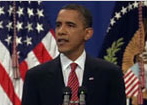
 So your mother told you that one day you also can be president ...She exaggerated a bit your chances of getting into the White House—nothwithstanding the recent episode with Michaele and Tareq Salahi. But today you can step into the presidential flight simulator and make a decision about how to handle the request of your generals to increase signanficantly the troops fighting in Afghanistan. The first article will take you behind the scences of the process that led to the decision over a three months period. Make your decision. Then think about how you would address the country. Give a little speach to anyone who want to listen. Next you can read or watch how Obama did address the nation. Finally, you can read two diametrically opposed reactions. David Brooks cheers your decision wheres Frank Rich finds it fundamentally flawed. After taking the ride, tell your mother whether you still want to be president.
How Obama Came to Plan for ‘Surge’ in Afghanistan
By PETER BAKER (NY Times, Dec 6, 2009)
WASHINGTON—On the afternoon he held the eighth meeting of his Afghanistan review, President Obama arrived in the White House Situation Room ruminating about war. He had come from Arlington National Cemetery, where he had wandered among the chalky white tombstones of those who had fallen in the rugged mountains of Central Asia.
How much their sacrifice weighed on him that Veterans Day last month, he did not say. But his advisers say he was haunted by the human toll as he wrestled with what to do about the eight-year-old war. Just a month earlier, he had mentioned to them his visits to wounded soldiers at the Army hospital in Washington. “I don’t want to be going to Walter Reed for another eight years,” he said then.
The economic cost was troubling him as well after he received a private budget memo estimating that an expanded presence would cost $1 trillion over 10 years, roughly the same as his health care plan.
Now as his top military adviser ran through a slide show of options, Mr. Obama expressed frustration. He held up a chart showing how reinforcements would flow into Afghanistan over 18 months and eventually begin to pull out, a bell curve that meant American forces would be there for years to come.
“I want this pushed to the left,” he told advisers, pointing to the bell curve. In other words, the troops should be in sooner, then out sooner.
When the history of the Obama presidency is written, that day with the chart may prove to be a turning point, the moment a young commander in chief set in motion a high-stakes gamble to turn around a losing war. By moving the bell curve to the left, Mr. Obama decided to send 30,000 troops mostly in the next six months and then begin pulling them out a year after that, betting that a quick jolt of extra forces could knock the enemy back on its heels enough for the Afghans to take over the fight.
The three-month review that led to the escalate-then-exit strategy is a case study in decision making in the Obama White House—intense, methodical, rigorous, earnest and at times deeply frustrating for nearly all involved. It was a virtual seminar in Afghanistan and Pakistan, led by a president described by one participant as something “between a college professor and a gentle cross-examiner.”
Mr. Obama peppered advisers with questions and showed an insatiable demand for information, taxing analysts who prepared three dozen intelligence reports for him and Pentagon staff members who churned out thousands of pages of documents.
This account of how the president reached his decision is based on dozens of interviews with participants as well as a review of notes some of them took during Mr. Obama’s 10 meetings with his national security team. Most of those interviewed spoke on the condition of anonymity to discuss internal deliberations, but their accounts have been matched against those of other participants wherever possible.
Mr. Obama devoted so much time to the Afghan issue—nearly 11 hours on the day after Thanksgiving alone—that he joked, “I’ve got more deeply in the weeds than a president should, and now you guys need to solve this.” He invited competing voices to debate in front of him, while guarding his own thoughts. Even David Axelrod, arguably his closest adviser, did not know where Mr. Obama would come out until just before Thanksgiving.
With the result uncertain, the outsize personalities on his team vied for his favor, sometimes sharply disagreeing as they made their arguments. The White House suspected the military of leaking details of the review to put pressure on the president. The military and the State Department suspected the White House of leaking to undercut the case for more troops. The president erupted at the leaks with an anger advisers had rarely seen, but he did little to shut down the public clash within his own government.
“The president welcomed a full range of opinions and invited contrary points of view,” Secretary of State Hillary Rodham Clinton said in an interview last month. “And I thought it was a very healthy experience because people took him up on it. And one thing we didn’t want—to have a decision made and then have somebody say, ‘Oh, by the way.’ No, come forward now or forever hold your peace.”
The decision represents a complicated evolution in Mr. Obama’s thinking. He began the process clearly skeptical of Gen. Stanley A. McChrystal’s request for 40,000 more troops, but the more he learned about the consequences of failure, and the more he narrowed the mission, the more he gravitated toward a robust if temporary buildup, guided in particular by Defense Secretary Robert M. Gates.
Yet even now, he appears ambivalent about what some call “Obama’s war.” Just two weeks before General McChrystal warned of failure at the end of August, Mr. Obama described Afghanistan as a “war of necessity.” When he announced his new strategy last week, those words were nowhere to be found. Instead, while recommitting to the war on Al Qaeda, he made clear that the larger struggle for Afghanistan had to be balanced against the cost in blood and treasure and brought to an end.
Aides, though, said the arduous review gave Mr. Obama comfort that he had found the best course he could. “The process was exhaustive, but any time you get the president of the United States to devote 25 hours, anytime you get that kind of commitment, you know it was serious business,” said Gen. James L. Jones, the president’s national security adviser. “From the very first meeting, everyone started with set opinions. And no opinion was the same by the end of the process.”
Taking Control of a War
Mr. Obama ran for president supportive of the so-called good war in Afghanistan and vowing to send more troops, but he talked about it primarily as a way of attacking Republicans for diverting resources to Iraq, which he described as a war of choice. Only after taking office, as casualties mounted and the Taliban gained momentum, did Mr. Obama really begin to confront what to do.
Even before completing a review of the war, he ordered the military to send 21,000 more troops there, bringing the force to 68,000. But tension between the White House and the military soon emerged when General Jones, a retired Marine four-star general, traveled to Afghanistan in the summer and was surprised to hear officers already talking about more troops. He made it clear that no more troops were in the offing.
With the approach of Afghanistan’s presidential election in August, Mr. Obama’s two new envoys—Richard C. Holbrooke, the president’s special representative to the region, and Lt. Gen. Karl W. Eikenberry, a retired commander of troops in Afghanistan now serving as ambassador—warned of trouble, including the possibility of angry Afghans marching on the American Embassy or outright civil war.
“There are 10 ways this can turn out,” one administration official said, summing up the envoys’ presentation, “and 9 of them are messy.”
The worst did not happen, but widespread fraud tainted the election and shocked some in the White House as they realized that their partner in Kabul, President Hamid Karzai, was hopelessly compromised in terms of public credibility.
At the same time, the Taliban kept making gains. The Central Intelligence Agency drew up detailed maps in August charting the steady progression of the Taliban’s takeover of Afghanistan, maps that would later be used extensively during the president’s review. General McChrystal submitted his own dire assessment of the situation, warning of “mission failure” without a fresh infusion of troops.
While General McChrystal did not submit a specific troop request at that point, the White House knew it was coming and set out to figure out what to do. General Jones organized a series of meetings that he envisioned lasting a few weeks. Before each one, he convened a rehearsal session to impose discipline—“get rid of the chaff,” one official put it—that included Vice President Joseph R. Biden Jr., Mrs. Clinton, Mr. Gates and other cabinet-level officials. Mr. Biden made a practice of writing a separate private memo to Mr. Obama before each meeting, outlining his thoughts.
The first meeting with the president took place on Sept. 13, a Sunday, and was not disclosed to the public that day. For hours, Mr. Obama and his top advisers pored through intelligence reports.
Unsatisfied, the president posed a series of questions: Does America need to defeat the Taliban to defeat Al Qaeda? Can a counterinsurgency strategy work in Afghanistan given the problems with its government? If the Taliban regained control of Afghanistan, would nuclear-armed Pakistan be next?
The deep skepticism he expressed at that opening session was reinforced by Mr. Biden, who rushed back overnight from a California trip to participate. Just as he had done in the spring, Mr. Biden expressed opposition to an expansive strategy requiring a big troop influx. Instead, he put an alternative on the table—rather than focus on nation building and population protection, do more to disrupt the Taliban, improve the quality of the training of Afghan forces and expand reconciliation efforts to peel off some Taliban fighters.
Mr. Biden quickly became the most outspoken critic of the expected McChrystal troop request, arguing that Pakistan was the bigger priority, since that is where Al Qaeda is mainly based. “He was the bull in the china shop,” said one admiring administration official.
But others were nodding their heads at some of what he was saying, too, including General Jones and Rahm Emanuel, the White House chief of staff.
A Review Becomes News
The quiet review burst into public view when General McChrystal’s secret report was leaked to Bob Woodward of The Washington Post a week after the first meeting. The general’s grim assessment jolted Washington and lent urgency to the question of what to do to avoid defeat in Afghanistan.
Adm. Mike Mullen, the chairman of the Joint Chiefs of Staff, and Gen. David H. Petraeus, the regional commander, secretly flew to an American air base in Germany for a four-hour meeting with General McChrystal on Sept. 25. He handed them his troop request on paper—there were no electronic versions and barely 20 copies in all.
The request outlined three options for different missions: sending 80,000 more troops to conduct a robust counterinsurgency campaign throughout the country; 40,000 troops to reinforce the southern and eastern areas where the Taliban are strongest; or 10,000 to 15,000 troops mainly to train Afghan forces.
General Petraeus took one copy, while Admiral Mullen took two back to Washington and dropped one off at Mr. Gates’s home next to his in a small military compound in Washington. But no one sent the document to the White House, intending to process it through the Pentagon review first.
Mr. Obama was focused on another report. At 10 p.m. on Sept. 29, he called over from the White House residence to the West Wing to ask for a copy of the first Afghanistan strategy he approved in March to ramp up the fight against Al Qaeda and the Taliban while increasing civilian assistance. A deputy national security adviser, Denis McDonough, brought him a copy to reread overnight. When his national security team met the next day, Mr. Obama complained that elements of that plan had never been enacted.
The group went over the McChrystal assessment and drilled in on what the core goal should be. Some thought that General McChrystal interpreted the March strategy more ambitiously than it was intended to be. Mr. Biden asked tough questions about whether there was any intelligence showing that the Taliban posed a threat to American territory. But Mr. Obama also firmly closed the door on any withdrawal. “I just want to say right now, I want to take off the table that we’re leaving Afghanistan,” he told his advisers.
Tension with the military had been simmering since the leak of the McChrystal report, which some in the White House took as an attempt to box in the president. The friction intensified on Oct. 1 when the general was asked after a speech in London whether a narrower mission, like the one Mr. Biden proposed, would succeed. “The short answer is no,” he said.
White House officials were furious, and Mr. Gates publicly scolded advisers who did not keep their advice to the president private. The furor rattled General McChrystal, who, unlike General Petraeus, was not a savvy Washington operator. And it stunned others in the military, who were at first “bewildered by how over the top the reaction was from the White House,” as one military official put it.
It also proved to be what one review participant called a “head-snapping” moment of revelation for the military. The president, they suddenly realized, was not simply updating his previous strategy but essentially starting over from scratch.
The episode underscored the uneasy relationship between the military and a new president who, aides said, was determined not to be as deferential as he believed his predecessor, George W. Bush, was for years in Iraq. And the military needed to adjust to a less experienced but more skeptical commander in chief. “We’d been chugging along for eight years under an administration that had become very adept at managing war in a certain way,” said another military official.
Moreover, Mr. Obama had read “Lessons in Disaster,” Gordon M. Goldstein’s book on the Vietnam War. The book had become a must read in the West Wing after Mr. Emanuel had dinner over the summer at the house of another deputy national security adviser, Thomas E. Donilon, and wandered into his library to ask what he should be reading.
Among the conclusions that Mr. Donilon and the White House team drew from the book was that both President John F. Kennedy and President Lyndon B. Johnson failed to question the underlying assumption about monolithic Communism and the domino theory—clearly driving the Obama advisers to rethink the nature of Al Qaeda and the Taliban.
The Pakistan Question
While public attention focused on Afghanistan, some of the most intensive discussion focused on the country where Mr. Obama could send no troops—Pakistan. Pushed in particular by Mrs. Clinton, the president’s team explored the links between the Afghan Taliban, the Pakistani Taliban and Al Qaeda, and Mr. Obama told aides that it did not matter how many troops were sent to Afghanistan if Pakistan remained a haven.
Many of the intelligence reports ordered by the White House during the review dealt with Pakistan’s stability and whether its military and intelligence services were now committed to the fight or secretly still supporting Taliban factions. According to two officials, there was a study of the potential vulnerability of Pakistan’s nuclear weapons, posing questions about potential insider threats and control of the warheads if the Pakistani government fell.
Mr. Obama and his advisers also considered options for stepping up the pursuit of extremists in Pakistan’s border areas. He eventually approved a C.I.A. request to expand the areas where remotely piloted aircraft could strike, and other covert action. The trick would be getting Pakistani consent, which still has not been granted.
On Oct. 9, Mr. Obama and his team reviewed General McChrystal’s troop proposals for the first time. Some in the White House were surprised by the numbers, assuming there would be a middle ground between 10,000 and 40,000.
“Why wasn’t there a 25 number?” one senior administration official asked in an interview. He then answered his own question: “It would have been too tempting.”
Mr. Gates and others talked about the limits of the American ability to actually defeat the Taliban; they were an indigenous force in Afghan society, part of the political fabric. This was a view shared by others around the table, including Leon E. Panetta, the director of the C.I.A., who argued that the Taliban could not be defeated as such and so the goal should be to drive wedges between those who could be reconciled with the Afghan government and those who could not be.
With Mr. Biden leading the skeptics, Mrs. Clinton, Mr. Gates and Admiral Mullen increasingly aligned behind a more robust force. Mrs. Clinton wanted to make sure she was a formidable player in the process. “She was determined that her briefing books would be just as thick and just as meticulous as those of the Pentagon,” said one senior adviser. She asked hard questions about Afghan troop training, unafraid of wading into Pentagon territory.
After a meeting where the Pentagon made a presentation with impressive color-coded maps, Mrs. Clinton returned to the State Department and told her aides, “We need maps,” as one recalled. She was overseas during the next meeting on Oct. 14, when aides used her new maps to show civilian efforts but she participated with headphones on from her government plane flying back from Russia.
Mr. Gates was a seasoned hand at such reviews, having served eight presidents and cycled in and out of the Situation Room since the days when it was served by a battery of fax machines. Like Mrs. Clinton, he was sympathetic to General McChrystal’s request, having resolved his initial concern that a buildup would fuel resentment the way the disastrous Soviet occupation of Afghanistan did in the 1980s.
But Mr. Gates’s low-wattage exterior masks a wily inside player, and he knew enough to keep his counsel early in the process to let it play out more first. “When to speak is important to him; when to signal is important to him,” said a senior Defense Department official.
On Oct. 22, the National Security Council produced what one official called a “consensus memo,” much of which originated out of the defense secretary’s office, concluding that the United States should focus on diminishing the Taliban insurgency but not destroying it; building up certain critical ministries; and transferring authority to Afghan security forces.
There was no consensus yet on troop numbers, however, so Mr. Obama called a smaller group of advisers together on Oct. 26 to finally press Mrs. Clinton and Mr. Gates. Mrs. Clinton made it clear that she was comfortable with General McChrystal’s request for 40,000 troops or something close to it; Mr. Gates also favored a big force.
Mr. Obama was leery. He had received a memo the day before from the Office of Management and Budget projecting that General McChrystal’s full 40,000-troop request on top of the existing deployment and reconstruction efforts would cost $1 trillion from 2010 to 2020, an adviser said. The president seemed in sticker shock, watching his domestic agenda vanishing in front of him. “This is a 10-year, trillion-dollar effort and does not match up with our interests,” he said.
Still, for the first time, he made it clear that he was ready to send more troops if a strategy could be found to ensure that it was not an endless war. He indicated that the Taliban had to be beaten back. “What do we need to break their momentum?” he asked.
Four days later, at a meeting with the Joint Chiefs of Staff on Oct. 30, he emphasized the need for speed. “Why can’t I get the troops in faster?” he asked. If they were going to do this, he concluded, it only made sense to do this quickly, to have impact and keep the war from dragging on forever. “This is America’s war,” he said. “But I don’t want to make an open-ended commitment.”
Bridging the Differences
Now that he had a sense of where Mr. Obama was heading, Mr. Gates began shaping a plan that would bridge the differences. He developed a 30,000-troop option that would give General McChrystal the bulk of his request, reasoning that NATO could make up most of the difference.
“If people are having trouble swallowing 40, let’s see if we can make this smaller and easier to swallow and still give the commander what he needs,” a senior Defense official said, summarizing the secretary’s thinking.
The plan, called Option 2A, was presented to the president on Nov. 11. Mr. Obama complained that the bell curve would take 18 months to get all the troops in place.
He turned to General Petraeus and asked him how long it took to get the so-called surge troops he commanded in Iraq in 2007. That was six months.
“What I’m looking for is a surge,” Mr. Obama said. “This has to be a surge.”
That represented a contrast from when Mr. Obama, as a presidential candidate, staunchly opposed President Bush’s buildup in Iraq. But unlike Mr. Bush, Mr. Obama wanted from the start to speed up a withdrawal as well. The military was told to come up with a plan to send troops quickly and then begin bringing them home quickly.
And in another twist, Mr. Obama, who campaigned as an apostle of transparency and had been announcing each Situation Room meeting publicly and even releasing pictures, was livid that details of the discussions were leaking out.
“What I’m not going to tolerate is you talking to the press outside of this room,” he scolded his advisers. “It’s a disservice to the process, to the country and to the men and women of the military.”
His advisers sat in uncomfortable silence. That very afternoon, someone leaked word of a cable sent by Ambassador Eikenberry from Kabul expressing reservations about a large buildup of forces as long as the Karzai government remained unreformed. At one of their meetings, General Petraeus had told Mr. Obama to think of elements of the Karzai government like “a crime syndicate.” Ambassador Eikenberry was suggesting, in effect, that America could not get in bed with the mob.
The leak of Ambassador Eikenberry’s Nov. 6 cable stirred another storm within the administration because the cable had been requested by the White House. The National Security Council had told the ambassador to put his views in writing. But someone else then passed word of the cable to reporters in what some in the process took to be a calculated attempt to head off a big troop buildup.
The cable stunned some in the military. The reaction at the Pentagon, said one official, was “Whiskey Tango Foxtrot”—military slang for an expression of shock. Among the officers caught off guard were General McChrystal and his staff, for whom the cable was “a complete surprise,” said another official, even though the commander and the ambassador meet three times a week.
A Presidential Order
By this point, the idea of some sort of time frame was taking on momentum. Mrs. Clinton talked to Mr. Karzai before the Afghan leader’s inauguration to a second term. She suggested that he use his speech to outline a schedule for taking over security of the country.
Mr. Karzai did just that, declaring that Afghan forces directed by Kabul would take charge of securing population centers in three years and the whole country in five. His pronouncement, orchestrated partly by Mrs. Clinton and diplomats in Kabul, provided a predicate for Mr. Obama to set out his own time frame.
The president gathered his team in the Situation Room at 8:15 p.m. on Nov. 23, the unusual nighttime hour adding to what one participant called a momentous wartime feeling. The room was strewn with coffee cups and soda cans.
Mr. Obama presented a revised version of Option 2A, this one titled “Max Leverage,” pushing 30,000 troops into Afghanistan by mid-2010 and beginning to pull them out by July 2011. Admiral Mullen came up with the date at the direction of Mr. Obama, despite some misgivings from the Pentagon about setting a time frame for a withdrawal. The date was two years from the arrival of the first reinforcements Mr. Obama sent shortly after taking office. Mr. Biden had written a memo before the meeting talking about the need for “proof of concept”—in other words, two years ought to be enough for extra troops to demonstrate whether a buildup would work.
The president went around the room asking for opinions. Mr. Biden again expressed skepticism, even at this late hour when the tide had turned against him in terms of the troop number. But he had succeeded in narrowing the scope of the mission to protect population centers and setting the date to begin withdrawal. Others around the table concurred with the plan. Mr. Obama spoke last, but still somewhat elliptically. Some advisers said they walked out into the night after 10 p.m., uncertain whether the president had actually endorsed the Max Leverage option or was just testing for reaction.
Two days later, Mr. Obama met with Nancy Pelosi, the House speaker and a critic of the Afghan war. The president outlined his plans for the buildup without disclosing specific numbers. Ms. Pelosi was unenthusiastic and pointedly told the president that he could not rely on Democrats alone to pass financing for the war.
The White House had spent little time courting Congress to this point. Even though it would need Republican support, the White House had made no overtures to the party leaders.
But there was back-channel contact. Mr. Emanuel was talking with Senator Lindsey Graham, Republican of South Carolina, who urged him to settle on a troop number “that began with 3” to win Republican support. “I said as long as the generals are O.K. and there is a meaningful number, you will be O.K.,” Mr. Graham recalled.
The day after Thanksgiving, Mr. Obama huddled with aides from 10:30 a.m. to 9:15 p.m. refining parameters for the plan and mapping out his announcement. He told his speechwriter, Ben Rhodes, that he wanted to directly rebut the comparison with Vietnam.
On the following Sunday, Nov. 29, he summoned his national security team to the Oval Office. He had made his decision. He would send 30,000 troops as quickly as possible, then begin the withdrawal in July 2011. In deference to Mr. Gates’s concerns, the pace and endpoint of the withdrawal would be determined by conditions at the time.
“I’m not asking you to change what you believe,” the president told his advisers. “But if you do not agree with me, say so now.” There was a pause and no one said anything.
“Tell me now,” he repeated.
Mr. Biden asked only if this constituted a presidential order. Mr. Gates and others signaled agreement.
“Fully support, sir,” Admiral Mullen said.
“Ditto,” General Petraeus said.
Mr. Obama then went to the Situation Room to call General McChrystal and Ambassador Eikenberry. The president made it clear that in the next assessment in December 2010 he would not contemplate more troops. “It will only be about the flexibility in how we draw down, not if we draw down,” he said.
Two days later, Mr. Obama flew to West Point to give his speech. After three months of agonizing review, he seemed surprisingly serene. “He was,” said one adviser, “totally at peace.”
Eisenhower Hall Theatre, United States Military Academy at West Point, West Point, New York
Dec 1, 2009. 8:01 P.M. EST
THE PRESIDENT: Good evening. To the United States Corps of Cadets, to the men and women of our Armed Services, and to my fellow Americans: I want to speak to you tonight about our effort in Afghanistan—the nature of our commitment there, the scope of our interests, and the strategy that my administration will pursue to bring this war to a successful conclusion. It’s an extraordinary honor for me to do so here at West Point—where so many men and women have prepared to stand up for our security, and to represent what is finest about our country.
To address these important issues, it’s important to recall why America and our allies were compelled to fight a war in Afghanistan in the first place. We did not ask for this fight. On September 11, 2001, 19 men hijacked four airplanes and used them to murder nearly 3,000 people. They struck at our military and economic nerve centers. They took the lives of innocent men, women, and children without regard to their faith or race or station. Were it not for the heroic actions of passengers onboard one of those flights, they could have also struck at one of the great symbols of our democracy in Washington, and killed many more.
As we know, these men belonged to al Qaeda—a group of extremists who have distorted and defiled Islam, one of the world’s great religions, to justify the slaughter of innocents. Al Qaeda’s base of operations was in Afghanistan, where they were harbored by the Taliban—a ruthless, repressive and radical movement that seized control of that country after it was ravaged by years of Soviet occupation and civil war, and after the attention of America and our friends had turned elsewhere.
Just days after 9/11, Congress authorized the use of force against al Qaeda and those who harbored them—an authorization that continues to this day. The vote in the Senate was 98 to nothing. The vote in the House was 420 to 1. For the first time in its history, the North Atlantic Treaty Organization invoked Article 5—the commitment that says an attack on one member nation is an attack on all. And the United Nations Security Council endorsed the use of all necessary steps to respond to the 9/11 attacks. America, our allies and the world were acting as one to destroy al Qaeda’s terrorist network and to protect our common security.
Under the banner of this domestic unity and international legitimacy—and only after the Taliban refused to turn over Osama bin Laden—we sent our troops into Afghanistan. Within a matter of months, al Qaeda was scattered and many of its operatives were killed. The Taliban was driven from power and pushed back on its heels. A place that had known decades of fear now had reason to hope. At a conference convened by the U.N., a provisional government was established under President Hamid Karzai. And an International Security Assistance Force was established to help bring a lasting peace to a war-torn country.
Then, in early 2003, the decision was made to wage a second war, in Iraq. The wrenching debate over the Iraq war is well-known and need not be repeated here. It’s enough to say that for the next six years, the Iraq war drew the dominant share of our troops, our resources, our diplomacy, and our national attention—and that the decision to go into Iraq caused substantial rifts between America and much of the world.
Today, after extraordinary costs, we are bringing the Iraq war to a responsible end. We will remove our combat brigades from Iraq by the end of next summer, and all of our troops by the end of 2011. That we are doing so is a testament to the character of the men and women in uniform. (Applause.) Thanks to their courage, grit and perseverance, we have given Iraqis a chance to shape their future, and we are successfully leaving Iraq to its people.
But while we’ve achieved hard-earned milestones in Iraq, the situation in Afghanistan has deteriorated. After escaping across the border into Pakistan in 2001 and 2002, al Qaeda’s leadership established a safe haven there. Although a legitimate government was elected by the Afghan people, it’s been hampered by corruption, the drug trade, an under-developed economy, and insufficient security forces.
Over the last several years, the Taliban has maintained common cause with al Qaeda, as they both seek an overthrow of the Afghan government. Gradually, the Taliban has begun to control additional swaths of territory in Afghanistan, while engaging in increasingly brazen and devastating attacks of terrorism against the Pakistani people.
Now, throughout this period, our troop levels in Afghanistan remained a fraction of what they were in Iraq. When I took office, we had just over 32,000 Americans serving in Afghanistan, compared to 160,000 in Iraq at the peak of the war. Commanders in Afghanistan repeatedly asked for support to deal with the reemergence of the Taliban, but these reinforcements did not arrive. And that’s why, shortly after taking office, I approved a longstanding request for more troops. After consultations with our allies, I then announced a strategy recognizing the fundamental connection between our war effort in Afghanistan and the extremist safe havens in Pakistan. I set a goal that was narrowly defined as disrupting, dismantling, and defeating al Qaeda and its extremist allies, and pledged to better coordinate our military and civilian efforts.
Since then, we’ve made progress on some important objectives. High-ranking al Qaeda and Taliban leaders have been killed, and we’ve stepped up the pressure on al Qaeda worldwide. In Pakistan, that nation’s army has gone on its largest offensive in years. In Afghanistan, we and our allies prevented the Taliban from stopping a presidential election, and—although it was marred by fraud—that election produced a government that is consistent with Afghanistan’s laws and constitution.
Yet huge challenges remain. Afghanistan is not lost, but for several years it has moved backwards. There’s no imminent threat of the government being overthrown, but the Taliban has gained momentum. Al Qaeda has not reemerged in Afghanistan in the same numbers as before 9/11, but they retain their safe havens along the border. And our forces lack the full support they need to effectively train and partner with Afghan security forces and better secure the population. Our new commander in Afghanistan—General McChrystal—has reported that the security situation is more serious than he anticipated. In short: The status quo is not sustainable.
As cadets, you volunteered for service during this time of danger. Some of you fought in Afghanistan. Some of you will deploy there. As your Commander-in-Chief, I owe you a mission that is clearly defined, and worthy of your service. And that’s why, after the Afghan voting was completed, I insisted on a thorough review of our strategy. Now, let me be clear: There has never been an option before me that called for troop deployments before 2010, so there has been no delay or denial of resources necessary for the conduct of the war during this review period. Instead, the review has allowed me to ask the hard questions, and to explore all the different options, along with my national security team, our military and civilian leadership in Afghanistan, and our key partners. And given the stakes involved, I owed the American people—and our troops—no less.
This review is now complete. And as Commander-in-Chief, I have determined that it is in our vital national interest to send an additional 30,000 U.S. troops to Afghanistan. After 18 months, our troops will begin to come home. These are the resources that we need to seize the initiative, while building the Afghan capacity that can allow for a responsible transition of our forces out of Afghanistan.
I do not make this decision lightly. I opposed the war in Iraq precisely because I believe that we must exercise restraint in the use of military force, and always consider the long-term consequences of our actions. We have been at war now for eight years, at enormous cost in lives and resources. Years of debate over Iraq and terrorism have left our unity on national security issues in tatters, and created a highly polarized and partisan backdrop for this effort. And having just experienced the worst economic crisis since the Great Depression, the American people are understandably focused on rebuilding our economy and putting people to work here at home.
Most of all, I know that this decision asks even more of you—a military that, along with your families, has already borne the heaviest of all burdens. As President, I have signed a letter of condolence to the family of each American who gives their life in these wars. I have read the letters from the parents and spouses of those who deployed. I visited our courageous wounded warriors at Walter Reed. I’ve traveled to Dover to meet the flag-draped caskets of 18 Americans returning home to their final resting place. I see firsthand the terrible wages of war. If I did not think that the security of the United States and the safety of the American people were at stake in Afghanistan, I would gladly order every single one of our troops home tomorrow.
So, no, I do not make this decision lightly. I make this decision because I am convinced that our security is at stake in Afghanistan and Pakistan. This is the epicenter of violent extremism practiced by al Qaeda. It is from here that we were attacked on 9/11, and it is from here that new attacks are being plotted as I speak. This is no idle danger; no hypothetical threat. In the last few months alone, we have apprehended extremists within our borders who were sent here from the border region of Afghanistan and Pakistan to commit new acts of terror. And this danger will only grow if the region slides backwards, and al Qaeda can operate with impunity. We must keep the pressure on al Qaeda, and to do that, we must increase the stability and capacity of our partners in the region.
Of course, this burden is not ours alone to bear. This is not just America’s war. Since 9/11, al Qaeda’s safe havens have been the source of attacks against London and Amman and Bali. The people and governments of both Afghanistan and Pakistan are endangered. And the stakes are even higher within a nuclear-armed Pakistan, because we know that al Qaeda and other extremists seek nuclear weapons, and we have every reason to believe that they would use them.
These facts compel us to act along with our friends and allies. Our overarching goal remains the same: to disrupt, dismantle, and defeat al Qaeda in Afghanistan and Pakistan, and to prevent its capacity to threaten America and our allies in the future.
To meet that goal, we will pursue the following objectives within Afghanistan. We must deny al Qaeda a safe haven. We must reverse the Taliban’s momentum and deny it the ability to overthrow the government. And we must strengthen the capacity of Afghanistan’s security forces and government so that they can take lead responsibility for Afghanistan’s future.
We will meet these objectives in three ways. First, we will pursue a military strategy that will break the Taliban’s momentum and increase Afghanistan’s capacity over the next 18 months.
The 30,000 additional troops that I’m announcing tonight will deploy in the first part of 2010—the fastest possible pace—so that they can target the insurgency and secure key population centers. They’ll increase our ability to train competent Afghan security forces, and to partner with them so that more Afghans can get into the fight. And they will help create the conditions for the United States to transfer responsibility to the Afghans.
Because this is an international effort, I’ve asked that our commitment be joined by contributions from our allies. Some have already provided additional troops, and we’re confident that there will be further contributions in the days and weeks ahead. Our friends have fought and bled and died alongside us in Afghanistan. And now, we must come together to end this war successfully. For what’s at stake is not simply a test of NATO’s credibility—what’s at stake is the security of our allies, and the common security of the world.
But taken together, these additional American and international troops will allow us to accelerate handing over responsibility to Afghan forces, and allow us to begin the transfer of our forces out of Afghanistan in July of 2011. Just as we have done in Iraq, we will execute this transition responsibly, taking into account conditions on the ground. We’ll continue to advise and assist Afghanistan’s security forces to ensure that they can succeed over the long haul. But it will be clear to the Afghan government—and, more importantly, to the Afghan people—that they will ultimately be responsible for their own country.
Second, we will work with our partners, the United Nations, and the Afghan people to pursue a more effective civilian strategy, so that the government can take advantage of improved security.
This effort must be based on performance. The days of providing a blank check are over. President Karzai’s inauguration speech sent the right message about moving in a new direction. And going forward, we will be clear about what we expect from those who receive our assistance. We’ll support Afghan ministries, governors, and local leaders that combat corruption and deliver for the people. We expect those who are ineffective or corrupt to be held accountable. And we will also focus our assistance in areas—such as agriculture—that can make an immediate impact in the lives of the Afghan people.
The people of Afghanistan have endured violence for decades. They’ve been confronted with occupation—by the Soviet Union, and then by foreign al Qaeda fighters who used Afghan land for their own purposes. So tonight, I want the Afghan people to understand—America seeks an end to this era of war and suffering. We have no interest in occupying your country. We will support efforts by the Afghan government to open the door to those Taliban who abandon violence and respect the human rights of their fellow citizens. And we will seek a partnership with Afghanistan grounded in mutual respect—to isolate those who destroy; to strengthen those who build; to hasten the day when our troops will leave; and to forge a lasting friendship in which America is your partner, and never your patron.
Third, we will act with the full recognition that our success in Afghanistan is inextricably linked to our partnership with Pakistan.
We’re in Afghanistan to prevent a cancer from once again spreading through that country. But this same cancer has also taken root in the border region of Pakistan. That’s why we need a strategy that works on both sides of the border.
In the past, there have been those in Pakistan who’ve argued that the struggle against extremism is not their fight, and that Pakistan is better off doing little or seeking accommodation with those who use violence. But in recent years, as innocents have been killed from Karachi to Islamabad, it has become clear that it is the Pakistani people who are the most endangered by extremism. Public opinion has turned. The Pakistani army has waged an offensive in Swat and South Waziristan. And there is no doubt that the United States and Pakistan share a common enemy.
In the past, we too often defined our relationship with Pakistan narrowly. Those days are over. Moving forward, we are committed to a partnership with Pakistan that is built on a foundation of mutual interest, mutual respect, and mutual trust. We will strengthen Pakistan’s capacity to target those groups that threaten our countries, and have made it clear that we cannot tolerate a safe haven for terrorists whose location is known and whose intentions are clear. America is also providing substantial resources to support Pakistan’s democracy and development. We are the largest international supporter for those Pakistanis displaced by the fighting. And going forward, the Pakistan people must know America will remain a strong supporter of Pakistan’s security and prosperity long after the guns have fallen silent, so that the great potential of its people can be unleashed.
These are the three core elements of our strategy: a military effort to create the conditions for a transition; a civilian surge that reinforces positive action; and an effective partnership with Pakistan.
I recognize there are a range of concerns about our approach. So let me briefly address a few of the more prominent arguments that I’ve heard, and which I take very seriously.
First, there are those who suggest that Afghanistan is another Vietnam. They argue that it cannot be stabilized, and we’re better off cutting our losses and rapidly withdrawing. I believe this argument depends on a false reading of history. Unlike Vietnam, we are joined by a broad coalition of 43 nations that recognizes the legitimacy of our action. Unlike Vietnam, we are not facing a broad-based popular insurgency. And most importantly, unlike Vietnam, the American people were viciously attacked from Afghanistan, and remain a target for those same extremists who are plotting along its border. To abandon this area now—and to rely only on efforts against al Qaeda from a distance—would significantly hamper our ability to keep the pressure on al Qaeda, and create an unacceptable risk of additional attacks on our homeland and our allies.
Second, there are those who acknowledge that we can’t leave Afghanistan in its current state, but suggest that we go forward with the troops that we already have. But this would simply maintain a status quo in which we muddle through, and permit a slow deterioration of conditions there. It would ultimately prove more costly and prolong our stay in Afghanistan, because we would never be able to generate the conditions needed to train Afghan security forces and give them the space to take over.
Finally, there are those who oppose identifying a time frame for our transition to Afghan responsibility. Indeed, some call for a more dramatic and open-ended escalation of our war effort —one that would commit us to a nation-building project of up to a decade. I reject this course because it sets goals that are beyond what can be achieved at a reasonable cost, and what we need to achieve to secure our interests. Furthermore, the absence of a time frame for transition would deny us any sense of urgency in working with the Afghan government. It must be clear that Afghans will have to take responsibility for their security, and that America has no interest in fighting an endless war in Afghanistan.
As President, I refuse to set goals that go beyond our responsibility, our means, or our interests. And I must weigh all of the challenges that our nation faces. I don’t have the luxury of committing to just one. Indeed, I’m mindful of the words of President Eisenhower, who—in discussing our national security—said, “Each proposal must be weighed in the light of a broader consideration: the need to maintain balance in and among national programs.”
Over the past several years, we have lost that balance. We’ve failed to appreciate the connection between our national security and our economy. In the wake of an economic crisis, too many of our neighbors and friends are out of work and struggle to pay the bills. Too many Americans are worried about the future facing our children. Meanwhile, competition within the global economy has grown more fierce. So we can’t simply afford to ignore the price of these wars.
All told, by the time I took office the cost of the wars in Iraq and Afghanistan approached a trillion dollars. Going forward, I am committed to addressing these costs openly and honestly. Our new approach in Afghanistan is likely to cost us roughly $30 billion for the military this year, and I’ll work closely with Congress to address these costs as we work to bring down our deficit.
But as we end the war in Iraq and transition to Afghan responsibility, we must rebuild our strength here at home. Our prosperity provides a foundation for our power. It pays for our military. It underwrites our diplomacy. It taps the potential of our people, and allows investment in new industry. And it will allow us to compete in this century as successfully as we did in the last. That’s why our troop commitment in Afghanistan cannot be open-ended—because the nation that I’m most interested in building is our own.
Now, let me be clear: None of this will be easy. The struggle against violent extremism will not be finished quickly, and it extends well beyond Afghanistan and Pakistan. It will be an enduring test of our free society, and our leadership in the world. And unlike the great power conflicts and clear lines of division that defined the 20th century, our effort will involve disorderly regions, failed states, diffuse enemies.
So as a result, America will have to show our strength in the way that we end wars and prevent conflict—not just how we wage wars. We’ll have to be nimble and precise in our use of military power. Where al Qaeda and its allies attempt to establish a foothold—whether in Somalia or Yemen or elsewhere—they must be confronted by growing pressure and strong partnerships.
And we can’t count on military might alone. We have to invest in our homeland security, because we can’t capture or kill every violent extremist abroad. We have to improve and better coordinate our intelligence, so that we stay one step ahead of shadowy networks.
We will have to take away the tools of mass destruction. And that’s why I’ve made it a central pillar of my foreign policy to secure loose nuclear materials from terrorists, to stop the spread of nuclear weapons, and to pursue the goal of a world without them—because every nation must understand that true security will never come from an endless race for ever more destructive weapons; true security will come for those who reject them.
We’ll have to use diplomacy, because no one nation can meet the challenges of an interconnected world acting alone. I’ve spent this year renewing our alliances and forging new partnerships. And we have forged a new beginning between America and the Muslim world—one that recognizes our mutual interest in breaking a cycle of conflict, and that promises a future in which those who kill innocents are isolated by those who stand up for peace and prosperity and human dignity.
And finally, we must draw on the strength of our values—for the challenges that we face may have changed, but the things that we believe in must not. That’s why we must promote our values by living them at home—which is why I have prohibited torture and will close the prison at Guantanamo Bay. And we must make it clear to every man, woman and child around the world who lives under the dark cloud of tyranny that America will speak out on behalf of their human rights, and tend to the light of freedom and justice and opportunity and respect for the dignity of all peoples. That is who we are. That is the source, the moral source, of America’s authority.
Since the days of Franklin Roosevelt, and the service and sacrifice of our grandparents and great-grandparents, our country has borne a special burden in global affairs. We have spilled American blood in many countries on multiple continents. We have spent our revenue to help others rebuild from rubble and develop their own economies. We have joined with others to develop an architecture of institutions—from the United Nations to NATO to the World Bank—that provide for the common security and prosperity of human beings.
We have not always been thanked for these efforts, and we have at times made mistakes. But more than any other nation, the United States of America has underwritten global security for over six decades—a time that, for all its problems, has seen walls come down, and markets open, and billions lifted from poverty, unparalleled scientific progress and advancing frontiers of human liberty.
For unlike the great powers of old, we have not sought world domination. Our union was founded in resistance to oppression. We do not seek to occupy other nations. We will not claim another nation’s resources or target other peoples because their faith or ethnicity is different from ours. What we have fought for—what we continue to fight for—is a better future for our children and grandchildren. And we believe that their lives will be better if other peoples’ children and grandchildren can live in freedom and access opportunity. (Applause.)
As a country, we’re not as young—and perhaps not as innocent—as we were when Roosevelt was President. Yet we are still heirs to a noble struggle for freedom. And now we must summon all of our might and moral suasion to meet the challenges of a new age.
In the end, our security and leadership does not come solely from the strength of our arms. It derives from our people—from the workers and businesses who will rebuild our economy; from the entrepreneurs and researchers who will pioneer new industries; from the teachers that will educate our children, and the service of those who work in our communities at home; from the diplomats and Peace Corps volunteers who spread hope abroad; and from the men and women in uniform who are part of an unbroken line of sacrifice that has made government of the people, by the people, and for the people a reality on this Earth. (Applause.)
This vast and diverse citizenry will not always agree on every issue—nor should we. But I also know that we, as a country, cannot sustain our leadership, nor navigate the momentous challenges of our time, if we allow ourselves to be split asunder by the same rancor and cynicism and partisanship that has in recent times poisoned our national discourse.
It’s easy to forget that when this war began, we were united—bound together by the fresh memory of a horrific attack, and by the determination to defend our homeland and the values we hold dear. I refuse to accept the notion that we cannot summon that unity again. (Applause.) I believe with every fiber of my being that we—as Americans—can still come together behind a common purpose. For our values are not simply words written into parchment—they are a creed that calls us together, and that has carried us through the darkest of storms as one nation, as one people.
America—we are passing through a time of great trial. And the message that we send in the midst of these storms must be clear: that our cause is just, our resolve unwavering. We will go forward with the confidence that right makes might, and with the commitment to forge an America that is safer, a world that is more secure, and a future that represents not the deepest of fears but the highest of hopes. (Applause.)
Thank you. God bless you. May God bless the United States of America. (Applause.) Thank you very much. Thank you. (Applause.)
END 8:35 P.M. EST
The Analytic Mode
By DAVID BROOKS (NY Times, Dec 3, 2009)
Many Democrats are nostalgic for Barack Obama’s 2008 presidential campaign—for the passion, the clarity, the bliss-to-be-alive fervor. They argue that these things are missing in a cautious and emotionless White House.
But, of course, the Obama campaign, like all presidential campaigns, was built on a series of fictions. The first fiction was that government is a contest between truth and error. In reality, government is usually a contest between competing, unequal truths.
The second fiction was that to support a policy is to make it happen. In fact, in government power is exercised through other people. It is only by coaxing, prodding and compromise that presidents actually get anything done.
The third fiction was that we can begin the world anew. In fact, all problems and policies have already been worked by a thousand hands and the clay is mostly dry. Presidents are compelled to work with the material they have before them.
The fourth fiction was that leaders know the path ahead. In fact, they have general goals, but the way ahead is pathless and everything is shrouded by uncertainty.
All presidents have to adjust to these realities when they move to the White House. The only surprise with President Obama is how enthusiastically he has made the transition. He’s political, like any president, but he seems to vastly prefer the grays of governing to the simplicities of the campaign.
The election revolved around passionate rallies. The Obama White House revolves around a culture of debate. He leads long, analytic discussions, which bring competing arguments to the fore. He sometimes seems to preside over the arguments like a judge settling a lawsuit.
His policies are often a balance as he tries to accommodate different points of view. He doesn’t generally issue edicts. In matters foreign and domestic, he seems to spend a lot of time coaxing people along. His governing style, in short, is biased toward complexity.
This style has never been more evident than in his decision to expand the war in Afghanistan. America traditionally fights its wars in a spirit of moral fervor. Most war presidents cast themselves as heroes on a white charger, believing that no one heeds an uncertain trumpet.
Obama, on the other hand, cloaked himself in what you might call Niebuhrian modesty. His decision to expand the war is the most morally consequential one of his presidency so far, yet as the moral stakes rose, Obama’s emotional temperature cooled to just above freezing. He spoke Tuesday night in the manner of an unwilling volunteer, balancing the arguments within his administration by leading the country deeper in while pointing the way out.
Despite the ambivalence, he did act. This is not mishmash. With his two surges, Obama will more than double the number of American troops in Afghanistan. As Andrew Ferguson of The Weekly Standard pointed out, he is the first Democratic president in 40 years to deploy a significant number of troops into a war zone.
Those new troops are not themselves a strategy; they are enablers of an evolving strategy. Over the next year, there will be disasters, errors and surprises—as in all wars. But the generals will have more resources with which to cope and respond.
If the generals continue to find that stationing troops in the villages of Helmand Province leads to the revival of Afghan society, they will have the troops to do more of that. If they continue to find that order can be maintained only if social development accompanies military action, they will have more troops for that. We have no way of knowing now how those troops will end up being used. And we have no clue if it will be wise to withdraw them in July 2011.
The advantage of the Obama governing style is that his argument-based organization is a learning organization. Amid the torrent of memos and evidence and dispute, the Obama administration is able to adjust and respond more quickly than, say, the Bush administration ever did.
The disadvantage is the tendency to bureaucratize the war. Armed conflict is about morale, motivation, honor, fear and breaking the enemy’s will. The danger is that Obama’s analytic mode will neglect the intangibles that are the essence of the fight. It will fail to inspire and comfort. Soldiers and Marines don’t have the luxury of adopting President Obama’s calibrated stance since they are being asked to potentially sacrifice everything.
Barring a scientific breakthrough, we can’t merge Obama’s analysis with George Bush’s passion. But we should still be glad that he is governing the way he is. I loved covering the Obama campaign. But amid problems like Afghanistan and health care, it simply wouldn’t do to give gauzy speeches about the meaning of the word hope. It is in Obama’s nature to lead a government by symposium. Embrace the complexity. Learn to live with the dispassion.
Obama’s Logic Is No Match for Afghanistan
By FRANK RICH (NY Times, Dec 6, 2009)
AFTER the dramatic three-month buildup, you’d think that Barack Obama’s speech announcing his policy for Afghanistan would be the most significant news story of the moment. History may take a different view. When we look back at this turning point in America’s longest war, we may discover that a relatively trivial White House incident, the gate-crashing by a couple of fame-seeking bozos, was the more telling omen of what was to come.
Obama’s speech, for all its thoughtfulness and sporadic elo


Your Comments
3 Responses. Comments closed for this entry.