

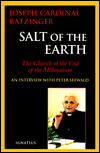
 In 1996 Joseph Cardinal Ratzinger, who recently became Pope Bednedict XVI, sat down with Peter Seewald, a German journalist who had left the catholic church, for a long conservation that was published as a book in the following year. Salt of the Earth: Christianity and the Catholic Church at the End of the Millennium became a bestseller in catholic circles. On a visit to Germany (the homeland of the new pope) I stumbled upon the book on the coffee table of my host and started reading. It turned out to be so interesting that I spent the next day reading it cover to cover. Seewald asked Ratzinger all the questions that an unbeliever or critic of the catholic church might want to ask the high church officials. Seewald posed Ratzinger one tough question after another, and you wonder constantly whether Ratzinger will be able to give an intellectually satisfying answer. The picture of Ratzinger that emerges in this conversation is quite different than one that I had collected from reading worldy newspapers.
Instead of being merely a bulldog defending the traditions of the catholic church against any reform (since 1980s Ratzinger was in charge of the Congregation for the Doctrine of the Faith, the office that ran the inquisition during the middle ages) Ratzinger emerges as a brilliant intellectual and sharp cultural critic, whose heart is filled with love for human beings and the institutions of the church. If Ratzinger’s parents had not been so devout catholics, Ratzinger undoubtedly would have become one of the leading European intellectuals, perhaps even towering over Habermas, Focault, Derrida and the like. The man is brilliant, but his love for the institution of the church and its traditions is going to make him a relatively conservative pope rather than the liberal intellectual that he would have become if he had grown up in a non-religious home. The tragedy for any high priest of the chatholic church is that love of traditions and love of humanity are often not compatible.
Footnote: Ratzinger’s presentations of the catholic faith is very sharp. In the eyes or the heart of Seewald it was so convincing that he returned to the Catholic Church. Seewald then had a second conversation with Ratzinger that was published as God and the World in 1999. The book focuses on questions on how to live the catholic faith. It was dissappointing compared to the first one.

Your Comments
0 Responses. Comments closed for this entry.