

And here is a bit of the drama behind the lone Republican vote courtesy of the Washington Post
A vote to make or break a career
Lone House Republican supported health bill after abortion limited
By Perry Bacon Jr.
Monday, November 9, 2009
When Republican Anh “Joseph” Cao won a stunning victory in a heavily Democratic district in New Orleans last December, the GOP was so thrilled that House Minority Leader John A. Boehner sent a memo to his colleagues headlined “The Future is Cao.”
But on health care, Cao had for months considered bucking the party that embraced him, while the White House wooed his vote. And this weekend, as a group of Democrats gained momentum in their effort to limit abortion in the health-care reform bill, the staunch abortion opponent Cao dialed up the White House and said he might be able to offer the bipartisan-starved Democrats his support if the abortion limits were included in the bill.
By Saturday afternoon, President Obama was on the phone trying to close the deal. Cao pressed Obama for more federal funds for his Hurricane Katrina-ravaged district. Cao said Obama didn’t make him any guarantees. But the abortion amendment gave Cao, a former Jesuit seminarian, a way to stay true to his beliefs while trying to win a second term in a district that Obama won with 75 percent of the vote, though he denied looking toward his political future.
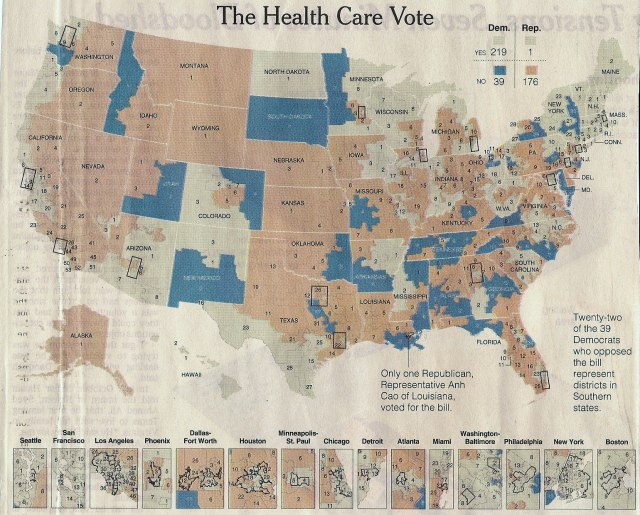
So on Saturday, Cao, the first Vietnamese American elected to Congress, surprised Democrats and Republicans by becoming the only one of the 177 House Republicans to support the historic health-care bill.
“I felt last night’s decision was the right decision for my district, even though it was not the popular decision for my party,” Cao told CNN on Sunday.
The decision, he said, was a lifeline to the poor and uninsured in his district, rejecting the idea that it had anything to do with reelection hopes. Members of both parties privately said, however, that Cao’s prospects are doomed unless a large number of Democrats in his district embrace him.
In a statement released by his office, Cao touted the abortion limits in the health bill, which had been insisted upon by the U.S. Conference of Catholic Bishops. Cao’s office also quoted Gregory M. Aymond, archbishop of New Orleans, who said, “I am grateful to Congressman Cao for his courage and determination to defend life.”
Democrats in Washington and New Orleans, noting how Cao has voted with Republicans on other issues, including opposition to the $787 billion economic stimulus package, said his record can’t be erased by his health-care vote. Democratic Party officials view Cao as one of the nation’s most vulnerable Republicans .
“He votes along party lines more than for the district,” said Louisiana State Rep. Cedric Richardson, a Democrat who hopes to unseat Cao next year.
Cao is well aware of his potentially short Washington career.
“I know that voting against the health-care bill will probably be the death of my political career,” Cao told the Times-Picayune earlier this year. But added, “I have to live with myself, and I always reflect on the phrase of the New Testament, ‘How does it profit a man’s life to gain the world but to lose his soul?’ ‘’
Cao, who at age 8 fled war-torn Vietnam after the fall of Saigon, moved to New Orleans after several missions as a Jesuit seminarian. He eventually left the priesthood and became a lawyer. His political activity increased after Hurricane Katrina, when he ran unsuccessfully for state representative as an independent. He was then recruited by the GOP to run for Congress.
In some ways, his victory was something of a fluke. Hurricane Gustav pushed back the election cycle last year, resulting in an early December contest that pitted Cao against Rep. William J. Jefferson, a nine-term incumbent who won reelection in 2006 despite widespread publicity about the FBI finding $90,000 in his freezer in 2005. With turnout much lower than in the presidential race a month earlier, Cao won an upset.
Boehner (Ohio) immediately argued that Republicans would win if they cast themselves as reformers like Cao. But the lawmaker had little connection to the GOP establishment, which did little to help him win.
Cao arrived in Congress focused on getting more money for hospitals and other things in his district. While he generally has voted with the GOP, Cao, 42, has occasionally bucked his party, such as his backing of a Democratic-pushed resolution to condemn Rep. Joe Wilson (R-S.C.) for shouting “You lie” during Obama’s speech on health care in September.
Nancy-Ann Deparle, director of the White House Office for Health Reform, has spoken repeatedly to Cao over the last several months about backing the reform effort, but abortion remained a sticking point.
On the eve of Saturday’s health-care vote, House Minority Whip Eric Cantor (R-Va.) predicted that every member of his party would oppose it. But as the effort to limit abortion, organized by Rep. Bart Stupak (D-Mich.), gained momentum, Cao became more likely to vote for the bill. In his discussions with the administration, Cao said he had received a “commitment from President Obama that he and I will work together to address the critical health-care issues of Louisiana.”
Cantor spent Saturday imploring Cao to vote no. Cantor’s last chance was during the 15 minutes members were given to vote Saturday night.
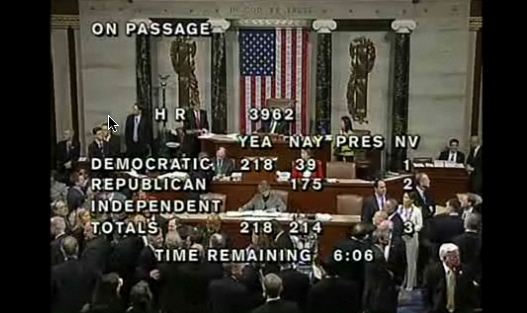
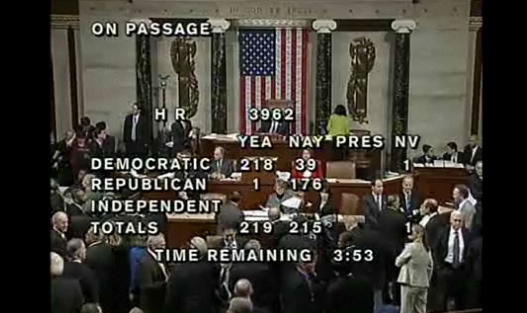
The GOP’s No. 2 leader sat down beside Cao on the Republican side of the chamber. As the two men chatted, they kept looking upward at the tally of members and their votes displayed on the wall high above where the representatives sit.
Although neither man nor their staffs have said what the two discussed, it became clear that Cao would not vote until after the Democrats had reached the required 218 to pass the bill. But once they did and began cheering, Cao became one of the last five members to cast his vote.
Cantor stood and walked away, while Rep. Michael M. Honda (D-Calif.) crossed the aisle to shake Cao’s hand.
John Murray, a Cantor spokesman, downplayed any tension saying Cao has a “tough district.”
Said Cao, “With the leadership, they respect my decision, and I respect theirs. At the end of the day, I had to make a decision of conscience based on the needs of the people in my district.”
And here from the Wall Street Journal
In Final Hours, an Intense Push for ‘Yes’ Votes
By JONATHAN WEISMAN and NAFTALI BENDAVID
WASHINGTON—For Rep. Dennis Cardoza, it was an assurance from House Speaker Nancy Pelosi that the drought afflicting California’s Central Valley would get high-level attention. For Rep. Michael Michaud, a liberal from Maine, it was personal coaxing from President Barack Obama Saturday morning. For Rep. Anh “Joseph” Cao, the lone Republican vote, it was multiple conversations with Obama administration officials, topped with new promises of support for his Katrina-ravaged New Orleans.
And for a large bloc of Democrats, a last-minute deal between the speaker and the Roman Catholic Church on abortion made the difference and secured passage of legislation offering near-universal health insurance.
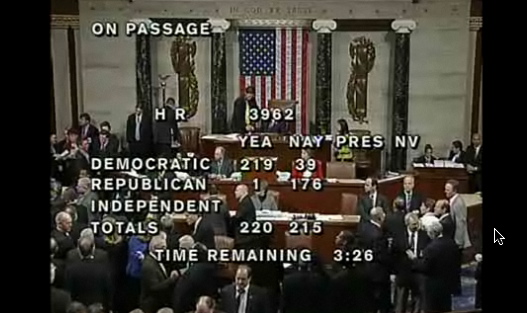
The 220-215 vote late Saturday gave Mr. Obama and the Democrats virtually no margin to spare. Special House election victories in upstate New York and California secured two votes Tuesday, the cushion Democrats ultimately needed four days later, one top aide said.
House leadership aides said they almost certainly could have won over some of the 39 Democrats who voted “no” if the bill would have failed otherwise. Still, the intense push showed a White House and House leadership team that was unsure of passage up to the final hours.
Republicans on Sunday showed they would try to extract a price for “yes” votes. The National Republican Congressional Committee targeted 47 Democrats it sees as vulnerable, saying they sided with “radical party leaders” and gave their “seal of approval for the Democrats’ government takeover of health care.”
Ms. Pelosi found herself in some unfamiliar situations. She has long stuck to her position in favor of abortion rights—despite opposition from Catholic leaders—but yielded in this case after negotiating with representatives of Catholic bishops.
The liberal speaker had to huddle Saturday with such like-minded lawmakers as Reps. Rosa DeLauro (D., Conn.) and Diana DeGette (D., Colo.) to explain why they should accept an antiabortion compromise many Democrats found distasteful.
Aides said Mr. Cardoza, a conservative Democrat, extracted a pledge from Ms. Pelosi to look more carefully at Central Valley lawmakers’ request for drought assistance. Some valley lawmakers, such as Rep. Devin Nunes (R., Calif.) want to suspend endangered-species restrictions to allow water to be diverted to farmland. Mr. Cardoza couldn’t be reached for comment Sunday.
Mr. Cao’s vote may have been easier to get. The Republican won his overwhelmingly Democratic seat from a Democrat, William Jefferson, who faced corruption charges. Antiabortion Democrats told White House legislative aides that Mr. Cao’s vote could be gotten with a deal on abortion. But according to two House officials, hurricane relief came up as well. Mr. Cao wants the Department of Homeland Security to forgive $1.27 billion in disaster loans in the wake of Hurricane Katrina; officials said they would try.
Promises of more attention to New Orleans were easy. Democratic leaders already knew they were likely to deliver similar pledges to Sen. Mary Landrieu (D., La.), another wavering lawmaker. Mr. Cao said in a statement that he won a commitment from Mr. Obama to address issues involving Louisiana hospitals and the disaster-loan forgiveness.
On Saturday, at a closed-door meeting of Democratic House members, Mr. Obama pulled aside Mr. Michaud to hear his concern that Maine would take an outsize hit from Medicare and Medicaid cuts in the bill. In a statement, Mr. Michaud said, “I am pleased that he understood my concerns as they relate to Maine and pledged to work with me to address them.”
For wavering lawmakers, Democratic leaders used a ratcheting-up strategy, aides said. Calls would come first from House Majority Leader Steny Hoyer (D., Md.), then the speaker, then White House senior adviser David Axelrod, then White House Chief of Staff Rahm Emanuel, and finally the president.
Sometimes it worked. Reps. Kurt Schrader, a freshman from Oregon, Jim Cooper of Tennessee and Melissa Bean of Illinois weren’t convinced that the bill’s cost—at more than $1 trillion—would be covered by spending cuts and tax increases, as predicted by the Congressional Budget Office. They pressed leaders for assurance that final negotiations with the Senate would yield a tax that House leaders hadn’t been willing to accept—a levy on high-cost insurance plans. Negotiators ultimately conceded that a final deal likely would.
Such appeals didn’t always work. Mr. Obama pressed Reps. Glenn Nye of Virginia, Betsy Markey of Colorado and Jason Altmire of Pennsylvania, relative newcomers from Republican-leaning districts. All three voted no.
Mr. Altmire, in an interview Sunday, described a courtship by Education Secretary Arne Duncan, Health and Human Services Secretary Kathleen Sebelius, Mr. Emanuel and, finally, the president.
According to Mr. Altmire’s recounting, Mr. Obama said the victory of a Democrat in a New York special election last Tuesday showed Mr. Altmire could survive a “yes” vote.
Mr. Altmire said he made another point: The bill would bring tens of millions of uninsured Americans into the health-care system but do too little to hold down costs. Mr. Obama said the bill is fully paid for. But, Mr. Altmire said, “I can make anything achieve balance if you raise taxes high enough.”
The two spoke briefly again Saturday morning. That afternoon, Mr. Altmire decided he couldn’t support the legislation.


Your Comments
0 Responses. Comments closed for this entry.