

Happiness Through the Ages
 What makes it so difficult to interpret how people in former times have thought about the human condition is that words change their meanings over time, sometimes morphing into the exact opposite of what they originally meant. As I just learned by reading in ‘The Economist’ a review of “Happiness: A History, ” the word “happiness” has changed its meaning considerably. I didn’t quite realize until today that if God wants speaks directly to people or at least their prophets, he or she has to master the idiom of a given age. To come across as really cool, God could walk up to a woman today and say, “Hey man, what’s up.” If God had done this two thousand years ago, a woman would likely have replied: “Almighty, I am sorry, but you are mistaken. I am a woman and not a man!”
William Wordsworth on Good and Evil
Adam Kirsch in his Dec 5, 2005, review in the New Yorker of Juliet Barker’s new biography Wordsworth: A Life writes that Woodsworth believed that the soul, uncontaminated by wealth and unperverted by extreme poverty, is essentially good; more, that it is part of a universal frame of goodndess, which can also also be glimpseed in mountains and rivers, animals and plants. Sin and death have no dominion over this goodness, which lies just underneath the surface of things, always ready to receive us. To support this interpretation, he provides these lines by the poet:
‘Tis Nature’s law
That none, the meanest of created things,
Of forms created the most vile and brute,
The dullest or most noxious, should exist
Divorced from good—a spirit and pulse
of good,
A life and soul, to every mode of being
Inseparably linked.
Transfixed in the Cineplex
DANIEL MARK EPSTEIN explains in the WSJ review of “The Power of Movies” what happens when we are at the movies.
Seduced, disturbed, beguiled—something strange and compelling happens when we watch a movie: When my daughter was four years old, we took her to see “The Wizard of Oz.” She emerged from the darkness transformed: For the next half-year, we had to set an extra place at the table for the Scarecrow, who had become her constant friend. The girl had gone so deeply into the world of the movie we wondered if she would ever return. Her experience had a certain resonance for me. The first movie I ever saw was “Hans Christian Andersen,” starring the golden-haired Danny Kaye. Since then I have never seriously considered any career other than the writer’s trade. If my first movie had been “High Noon,” would I have wanted to be a gunslinger? Or “The Red Shoes”—would it have made a ballet dancer of me?
Continue Reading
Winslow Homer at the National Gallery of Art in Washington
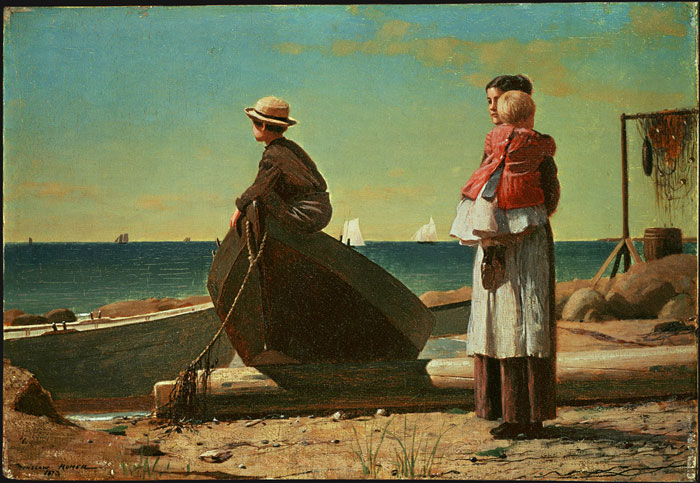
Dad’s Coming 1873. See the Online Catalog of the Exhibit.
Lincoln’s Great Drepression
 Surprisingly, the article on Lincoln’s state of mind in this month’s Atlantic Monthly turned out to be very interesting. Making valid inferences after the fact about what propelled a person to act in a particular way is difficult, to put it mildly. With hindsight everyone has perfect vision. Joshua Wolf Shenk’s Lincoln’s Great Depression does not fall into the trap of inferring a grand thesis from one case. Looking at Lincoln’s entire life he finds one episode after another in which Lincoln does not overcome his melancholy for good, but rather learns to live with his sadness and to turn it into a creative force. Shenk argues that Lincoln’s depression forced him to analyze himself and the world around himself, giving him a deeper insight into reality that prepared Lincoln to see more accurately the challenges of his time. Think about this startling implication: if George W. Bush would get a bit depressed, we might all be much better off!
A Conservative Columnist updates Karl Marx
David Brooks fills the role of William Safir as the conversative op-ed columnist in the NY Times. I often don’t agree with his columns but today he is written one that is right on the money about educational segregation.
Karl’s New Manifesto
By DAVID BROOKS (NYT)
I was in the library reading room when suddenly a strange specter of a man appeared above me. He was a ragged fellow with a bushy beard, dressed in the clothes of another century. He clutched news clippings on class in America, and atop the pile was a manifesto in his own hand. He was gone in an instant, but Karl’s manifesto on modern America remained. This is what it said:
Continue Reading
Why It Often Rains in the Movies
A few days ago, I read this wonderful short piece by Lawrence Raab in a book entitled “The Paris Review Book for Planes, Trains, Elevators, and Waiting Rooms” (p. 260).
Because so much consequential thinking
happens in the rain. A steady mist
to recall departures, a bitter downpour
for betrayal. As if the first thing
a man wants to do when he learns his wife
is sleeping with his best friend, and has been
for years, the very first thing
is not to make a drink, and drink it,
and make another, but to walk outside
into bad wheather. It’s true
The Golden Dream Goes on and on in Southern California
Verylyn Klinkenborg published today interesting travel notes in the NY Times.
Rereading the Landscape of an Essay by Joan Didion
SAN BERNARDINO, Calif.
Forty years ago this month, a housewife named Lucille Miller - just turning 35 - came to trial in San Bernardino for the murder of her husband, a dentist who was named Gordon Miller and called Cork. The murder was a clumsy one. Cork Miller burned to death in the back seat of a 1964 Volkswagen. According to the district attorney, Lucille Miller intended to make it look as if the car had rolled over an embankment and burst into flames. She would have had time in that deserted neighborhood to get home before the accident was reported. Instead, the car got stuck in the sand in low gear, and burst into flames anyway.
Continue ReadingInteresting Article in the New Yorker: “The Mistress’s Daughter”

The New Yorker once in a while publishes personal histories that are compelling because they touch upon core issues our lives, are deeply thought through, and are superbly written. The one I read last night by Amy Holmes is available on the web.

© 2026 Peter Murmann. Powered by ExpressionEngine.
