

The Cliffhanger: Read this before the election is over
 If you are not already on the edge of your seat, read this article before we know who is the next president.
How smart is the American voter?
The electorate as a whole may be wiser and more rational than any individual.
By Larry M. Bartels (LA Times)
One of the bestselling books of the 2008 election season has been “Just How Stupid Are We?” by popular historian Rick Shenkman. It presents a familiar collection of bleak results from opinion surveys documenting the many things most Americans don’t know about politics, government and history. “Public ignorance,” Shenkman concludes, is “the most obvious cause” of “the foolishness that marks so much of American politics.” But is that really true?
Continue ReadingCarl Rove False Predictions
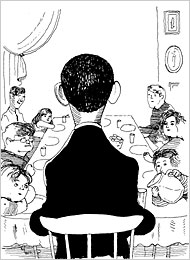 I wonder how long Carl Rove can continue peddling his “wisdom.” Frank Rich reports in the NYTimes:
Once Obama wrested the nomination from Clinton by surpassing her in organization, cash and black votes, he was still often seen as too wimpy to take on the Republicans. This prognosis was codified by Karl Rove, whose punditry for The Wall Street Journal and Newsweek has been second only to Jon Stewart and Stephen Colbert as a reliable source of laughs this year. Rove called Obama
Continue ReadingBlame game: GOP forms circular firing squad
 If McCain comes back to win this election, it will be the story of the year. It seems like the people with the McCain campaign don’t believe in victory anymore.
Report by: Jonathan Martin and Mike Allen and John F. Harris (Politico.com)
With despair rising even among many of John McCain
Continue ReadingSNL: The “Liberal Media Elite” is a lot Smarter than Sarah Palin
If the McCain campaign had discipline, it would have not allowed Palin to participate in SNL and look so stupid. SNL is truly clever exploiting the vanity of a vice presidential nominee to further the democratic ticket.
Continue Reading
Reactions to the Third Presidential Debate
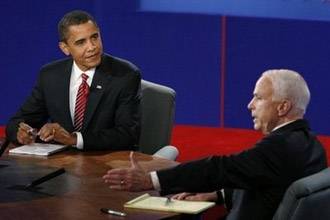 Once again the most useful piece of evaluation of the debate comes from the focus group run for Time.com. Amy Sullivan reports:
In politics it is generally not considered a good sign when voters are laughing at you, not with you. And by the end of the third and last presidential debate, the undecided voters who had gathered in Denver for Democratic pollster Stan Greenberg
Continue ReadingOBAMA WINS 2ND DEBATE
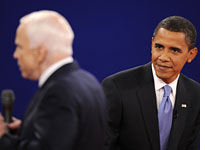 McCain has 27 days to find a better way to take on his opponent or he’ll be calling him Mr. President.
—John Dickerson in Slate.com
Click on more to read the analysis of how undecided voters reacted to the debate.
Continue ReadingThe State of the Presidential Race
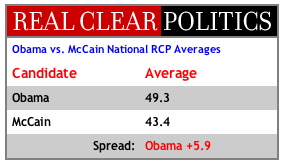
It is to early to open up the champaign bottles, but at the least the trends is going into the right direction. I am going to buy a good bottle for November 4 and let’s hope the final numbers allow me to drink it.
Tina Fey aka Sarah Palin is a Genius
I did not see this live. But poor Penny Noonan, who initially was shocked by the Palin nomination (Oh, my God, now it is over) wrote this bizarre endorsement/non-endorsement of Palin.
Palin the Populist
Joe Biden was no match for “Joe Six-Pack.”
By PEGGY NOONAN
She killed. She had him at “Nice to meet you. Hey, can I call you Joe?” She was the star. He was the second male lead, the good-natured best friend of the leading man. She was not petrified but peppy.
The whole debate was about Sarah Palin. She is not a person of thought but of action. Interviews are about thinking, about reflecting, marshaling data and integrating it into an answer. Debates are more active, more propelled—they are thrust and parry. They are for campaigners. She is a campaigner. Her syntax did not hold, but her magnetism did. At one point she literally winked at the nation.
As far as Mrs. Palin was concerned, Gwen Ifill was not there, and Joe Biden was not there. Sarah and the camera were there. This was classic “talk over the heads of the media straight to the people,” and it is a long time since I’ve seen it done so well, though so transparently. There were moments when she seemed to be doing an infomercial pitch for charm in politics. But it was an effective infomercial.
Joe Biden seems to have walked in thinking that she was an idiot and that he only had to patiently wait for this fact to reveal itself. This was a miscalculation. He showed great forbearance. Too much forbearance. She said of his intentions on Iraq, “Your plan is a white flag of surrender.” This deserved an indignant response, or at least a small bop on the head, from Mr. Biden, who has been for five years righter on Iraq than the Republican administration. He was instead mild.
The heart of her message was a complete populist pitch. “Joe Six-Pack” and “soccer moms” should unite to fight the tormentors who forced mortgages on us. She spoke of “Main Streeters like me.” A question is at what point shiny, happy populism becomes cheerful manipulation.
Sarah Palin saved John McCain again Thursday night. She is the political equivalent of cardiac paddles: Clear! Zap! We’ve got a beat! She will re-electrify the base. More than that, an hour and a half of talking to America will take her to a new level of stardom. Watch her crowds this weekend. She’s about to get jumpers, the old political name for people who are so excited to see you they start to jump.
Her triumph comes at an interesting time. The failure of the first bailout bill was an epic repudiation of the Washington leadership class by the American people. Two weeks ago the president of the United States, the speaker of the House, the secretary of the Treasury and the leadership of both parties in Congress came forward and announced that the economy was in crisis and a federal bill to solve it urgently needed. The powers were in agreement, the stars aligned, it was going to happen.
And then the phones began to ring, from one end of Capitol Hill to the other. And the message in those calls was, essentially: We don’t trust you to fix the problem, we suspect you may have caused it. Go away.
It was an epic snub, aimed at both parties. And the bill tanked.
We have simply, as a nation, never had a moment like this, in which the American people voted such a stunning no-confidence in America’s leaders in a time of real and present danger. The fate of the second bill is unclear as I write, but the fact that it has morphed from three pages to roughly 450, and is festooned with favors, will do nothing to allay public suspicions about the trustworthiness of Congress. This, as a background, could not have helped Mr. Biden.
We have never seen an economic meltdown like this? We’ve never seen a presidential meltdown like this. George W. Bush’s weakness is not all lame-duckship. In the last year of his presidency Ronald Reagan met with Mikhail Gorbachev in Moscow and helped change the world. In the penultimate year of his presidency, Bill Clinton sent U.S. troops, successfully, into Kosovo.
After the first bailout failed, Mr. Bush spoke like a man who was a mere commentator, not the leader in a crisis.
We witness here a great political lesson. When you are president, it matters—it really matters—that a majority of the people support and respect you. When you squander that affection, you lose more than mere popularity. You lose the ability to lead when your country is in crisis. This is a terrible loss, and a dangerous one, for the whole world is watching.
Young aides to Reagan used to grouse, late in his second term, that he had high popularity levels, that popularity was capital, and that he should spend it more freely on potential breakthroughs of this kind or that. But Reagan and the men around him were wiser. They spent when they had to and were otherwise prudent. (Is there a larger lesson here?) They were not daring when they didn’t have to be. They knew presidential popularity is a jewel to be protected, and to be burnished when possible, because without it you can do nothing. Without the support and trust of the people you cannot move, cannot command. You are left, like Mr. Bush, talking to an empty room.
We saw this week, too, a turn in the McCain campaign’s response to criticisms of Mrs. Palin. I find obnoxious the political game in which if you expressed doubts about the vice presidential nominee, or criticized her, you were treated as if you were knocking the real America—small towns, sound values. “It’s time that normal Joe Six-Pack American is finally represented in the position of vice presidency,” Mrs. Palin told talk-show host Hugh Hewitt. This left me trying to imagine Abe Lincoln saying he represents “backwoods types,” or FDR announcing that the fading New York aristocracy deserves another moment in the sun. I’m not sure the McCain campaign is aware of it—it’s possible they are—but this is subtly divisive. As for the dismissal of conservative critics of Mrs. Palin as “Georgetown cocktail party types” (that was Mr. McCain), well, my goodness. That is the authentic sound of the aggression, and phony populism, of the Bush White House. Good move. That ended well.
We must take happiness where we can. Tina Fey’s Sarah Palin has become, in that old phrase, a national sensation, and Ms. Fey is becoming, with her show “30 Rock,” and now the Palin impression, one of the great comic figures of her generation. Her work with Amy Poehler (as Katie Couric) in last weekend’s spoof on “Saturday Night Live” was so astoundingly good—the hand gestures, the vocal tone and spirit—that it captured some of the actual heart of the Palin story. Ms. Poehler as Couric: “Mrs. Palin, are you aware that when cornered you become increasingly adorable?” Ms. Fey as Palin mugs, adorably.
To spoof someone well takes talent, but to utterly nail a political figure while not brutalizing him takes a real gift, and amounts almost to a public service. After all, to capture someone is a kind of tribute: it concedes he is real, vivid, worthy of note. We are not as a nation manufacturing trust all that well, or competence, or leadership. But some things we do well, and one is comedy. Ms. Fey plays characters who are sour, stressed and who, on “30 Rock,” live in a world that is cynical, provisional and shallow. But to observe life so closely takes a kind of love.
Continue Reading

© 2026 Peter Murmann. Powered by ExpressionEngine.


